
The Bene Gesserit In Frank Herbert’s Dune
The Bene Gesserit of “Dune” stand at the crossroads of empire and prophecy, an austere sisterhood whose hidden breeding program and religious strategy shape the fate of civilizations across page and screen.

The Bene Gesserit In "Dune"
The Bene Gesserit are the quiet power in Frank Herbert's "Dune." They do not command armies, nor do they hold the throne. They shape the men who do.
For readers who came of age with paperbacks in the 1960s and 1970s, the Sisterhood represents something rare in science fiction. They are not space adventurers or gadget builders.
They are institutional thinkers. This article clarifies who they are, what they want, and how their long game drives the events of Herbert's six novels and the major screen adaptations.
Imperial Structure And Influence
The Imperium in "Dune" operates like a feudal system projected across the stars. The Padishah Emperor rules, the Great Houses compete within the Landsraad, and the Spacing Guild controls travel. The Bene Gesserit move within all three spheres.
They do not rule openly. They influence. A Sister may serve as wife, concubine, adviser, or Truthsayer. In each role, she gathers intelligence, shapes decisions, and nudges policy. Their strength lies in proximity to power rather than possession of it.
This distinction matters. The Sisterhood's authority depends on patience and placement, not spectacle.
| Field | Details |
|---|---|
| Name | Bene Gesserit Sisterhood |
| Affiliation | Imperial court of the Padishah Emperor; Great Houses of the Landsraad; Mother School on Wallach IX |
| First Appearance | "Dune" (1965) by Frank Herbert |
| Rank and Role | Quasi-monastic political order; advisers, concubines, Truthsayers; led by a Reverend Mother Superior |
| Description | All-female order trained in extreme mental and physical discipline, guiding galactic politics through long-term planning, strategic placement, and a generations-spanning breeding program |
| Notable Trait | Prana-bindu mastery, the Voice, and Other Memory acquired through the spice agony |
| Key Objective | To produce the Kwisatz Haderach and guide humanity along a controlled evolutionary path |
| Portrayed In | "Dune" (1984); "Frank Herbert’s Dune" (2000); "Frank Herbert’s Children of Dune" (2003); "Dune" (2021); "Dune Part Two" (2024) |
| Notable Member | Gaius Helen Mohiam; Lady Jessica; Reverend Mother Superior Taraza; Darwi Odrade |
Origins And Context
The Bene Gesserit function as a disciplined, hierarchical order. At the top stands the Reverend Mother Superior. Beneath her are Reverend Mothers and trained Sisters, each bound by oath and shared purpose.
They deny that they are a religion. In spite of that claim, they operate with ritual, litany, and spiritual trial. The spice agony, which transforms a Sister into a Reverend Mother, resembles a sacred ordeal. The contradiction is deliberate. It protects their freedom of action within a politically fragmented empire.
Their training is rigorous and concrete. Through prana-bindu conditioning, a Sister gains conscious control over muscle and nerve. He can regulate pain, adjust metabolism, and detect subtle shifts in posture and tone. Outsiders call it magic. Herbert presents it as discipline carried to its logical extreme.
A Reverend Mother who survives the spice agony gains Other Memory. She acquires the memories of her female ancestors, layered within her mind. This inheritance differs from prescience. It looks backward, not forward. That distinction becomes crucial when the breeding program enters the story.

The Breeding Program
The Sisterhood's most ambitious project unfolds over generations. They guide bloodlines across the Great Houses with a specific aim. They seek to produce the Kwisatz Haderach, a male who can combine Bene Gesserit discipline with expanded awareness.
In "Dune," Lady Jessica disrupts the timetable. Ordered to bear a daughter, she chooses to give Duke Leto a son. Paul Atreides arrives one generation early. That deviation reshapes the political balance of the Imperium.
SPOILER
In later novels, the consequences of this acceleration expose the limits of Bene Gesserit foresight. Their program achieves results, yet those results do not remain under their control.

Religion As Infrastructure
One of Herbert's sharpest ideas appears in the Missionaria Protectiva. The Sisterhood plants myths on developing worlds. These legends prepare local populations to accept a Bene Gesserit figure in a time of crisis.
On Arrakis, those planted beliefs create fertile ground for Paul's rise. The myths were not written for him alone. They were contingency plans, embedded in culture long before the story begins.
Here, Herbert examines faith as infrastructure. Belief can be engineered, preserved, and activated. The Bene Gesserit understand that religion moves men more reliably than decrees.

Role In The Story
The first chapter of "Dune" presents the Gom Jabbar test. A Reverend Mother orders Paul to place his hand in a box that inflicts intense pain. The test defines humanity as the ability to master instinct. It also announces the Sisterhood's standards.
Throughout the novel, the Bene Gesserit attempt to manage Paul's emergence. They test him, advise around him, and measure risk. They do not fully command him.
Their influence must also be weighed against other powers. The Emperor commands legions. The Guild controls interstellar travel. The Great Houses field armies. The Bene Gesserit command something less visible, yet often more durable. They command information, training, and bloodline.
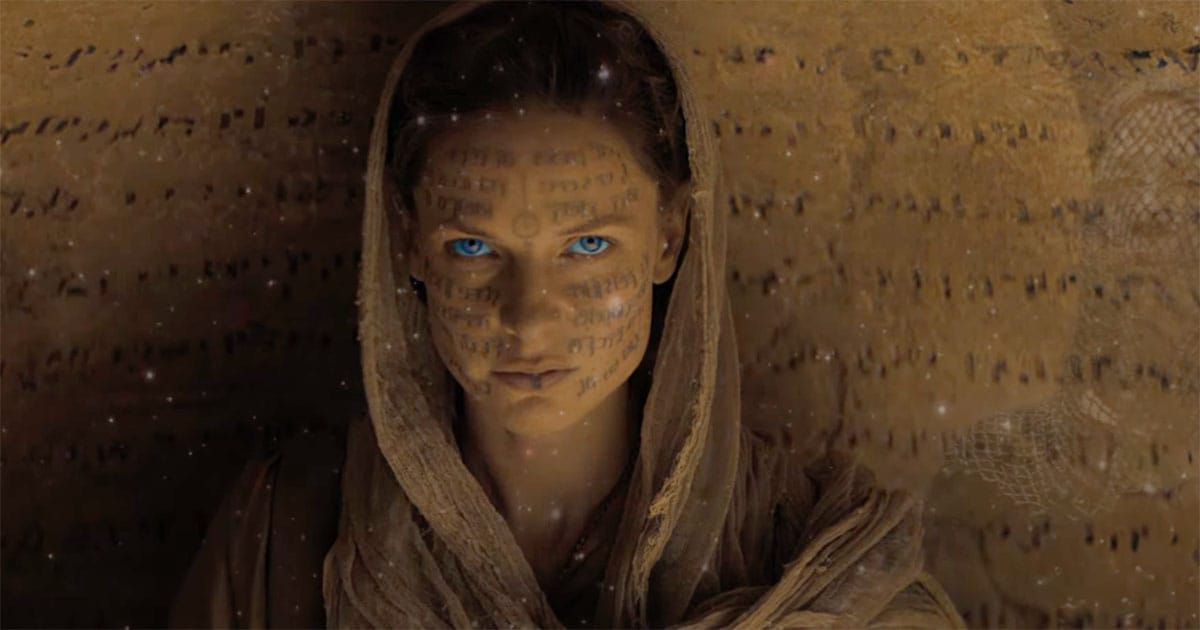
Film and television adaptations highlight different aspects of this authority. The 1984 "Dune" presents the Sisterhood with ornate ritual weight. The 2000 and 2003 miniseries emphasize court politics. The 2021 and 2024 films portray them with austere realism, focusing on the psychological precision of the Voice.

Enduring Significance
The Bene Gesserit embody Herbert's warning about long-term planning divorced from humility. They believe they can guide humanity toward stability. They achieve much. Yet history resists confinement.
For classic science fiction readers, the Sisterhood offers a serious meditation on power, faith, discipline, and consequence. They remain one of the most fully realized institutions in modern speculative fiction.