
"Arrakis" Why the Harshest World in Dune Matters Most
Arrakis is the desert planet at the heart of Dune. Learn how its harsh environment, spice production, and Fremen culture shape power, survival, and the fate of the Imperium.

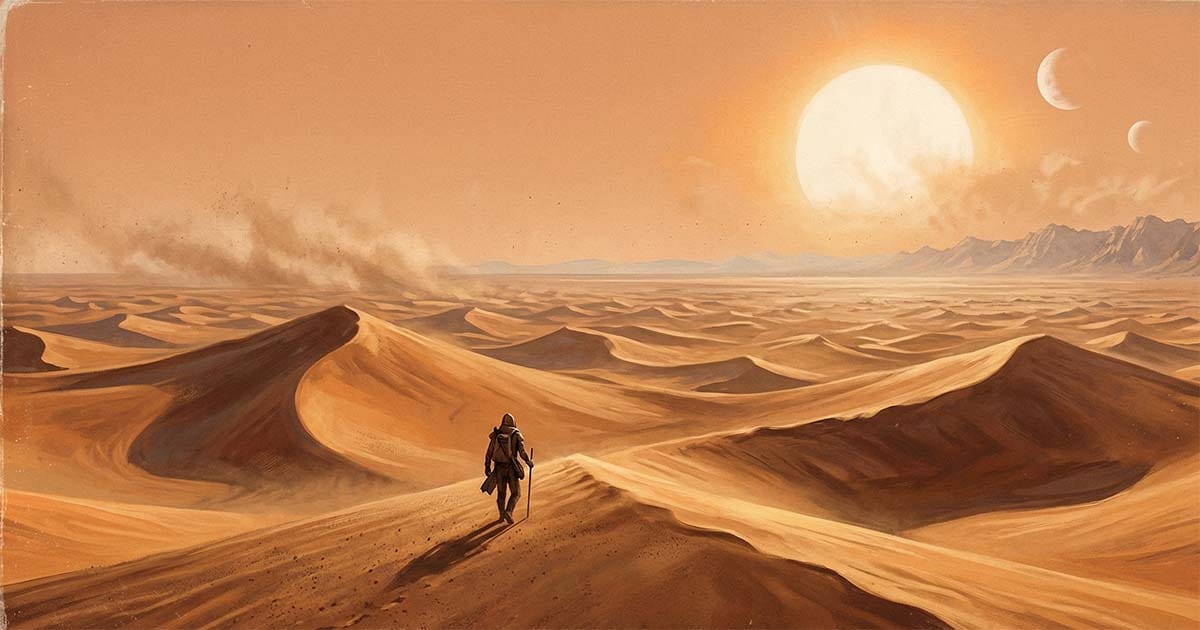
Arrakis is the most important world in "Dune," and the least hospitable. It is a desert planet where water is scarce, exposure is fatal, and survival depends on discipline. Yet this harsh world produces the spice melange, the single substance that holds the Imperium together.
That contradiction defines Arrakis. It is both wasteland and prize, both trap and opportunity. Every major conflict in "Dune" begins with the fact that no one can ignore it. The planet does not simply host the story. It determines what can happen and who can endure.
Origins And Context
When Frank Herbert introduced Arrakis in Dune, he presented more than a setting. He presented a controlled system built on limits.
The novel emerges from a period when concerns about ecology and finite resources were gaining attention. Arrakis reflects those concerns in their most severe form. Nothing is wasted because nothing can be replaced.
Film adaptations preserve this idea, even when their styles differ. Dune leans toward a heavier, industrial tone. Dune favors scale and restraint. In both cases, the central truth remains. The environment sets the rules, and human systems must adjust.
| Field | Information |
|---|---|
| Name | Arrakis |
| Aliases | Dune; later Rakis |
| Affiliation | Imperium; House Atreides; House Harkonnen; Fremen; Spacing Guild; Bene Gesserit |
| First Appearance | "Dune" (1965) by Frank Herbert |
| Description | Desert planet and sole source of spice melange. A harsh, water-scarce world whose extreme environment shapes its people, controls interstellar travel, and determines the balance of power across the Imperium. |
Geography And Climate
Arrakis is defined by dryness. There is almost no surface water, little vegetation, and no forgiving terrain. Vast sand seas dominate the landscape, broken only by rock formations and a few fortified cities.
Settlements like Arrakeen exist for administration and trade, but they do not tame the planet. Beyond them lies open desert, where the margin for error is small.
The Fremen avoid exposure by living in sietches carved into rock. These hidden communities conserve and store water with care. Every movement, every decision, reflects the same reality. On Arrakis, the environment is final authority.
Ecology And Spice Cycle
Spice gives Arrakis its importance. It extends life, sharpens awareness, and allows safe navigation across interstellar distances. Without it, the structure of the Imperium collapses.
Its origin is not simple extraction. It is the result of a closed ecological process. Sandtrout alter the distribution of water beneath the surface. Over time, pre-spice mass develops under pressure. When released, it becomes melange in the open desert.
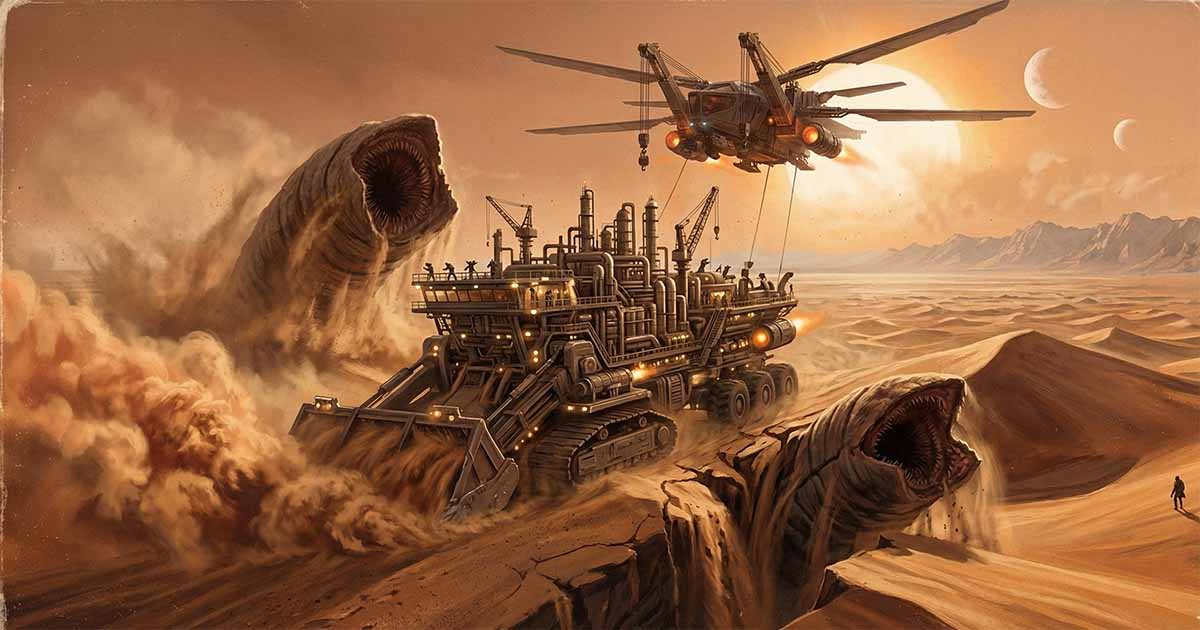
This process links biology, geology, and climate into a single system. It also introduces constant danger. Spice harvesting requires heavy machinery operating on open sand, where vibrations attract sandworms.
Some modern readers question the precision of this ecology. That is fair. What matters in the novel is consistency. Arrakis behaves like a world governed by rules, and those rules cannot be ignored without consequence.

Fremen Knowledge Systems
The Fremen survive because they understand Arrakis as a system, not an obstacle. Their stillsuits reclaim moisture from the body. Their sietches store water as a shared resource. Even their method of walking across the desert avoids patterns that attract worms.
This is more than technique. It is a culture shaped by necessity. Water is not simply valuable. It defines behavior and judgment.
Outsiders approach Arrakis with the assumption that technology or force can impose control. The Fremen approach it with discipline and patience. In the long run, that difference proves decisive.
Role In The Story
Arrakis drives the narrative of "Dune." Control of the planet brings House Atreides into conflict with House Harkonnen and the Emperor. What appears to be a political transfer of power is, in fact, a calculated risk.
For Paul Atreides, Arrakis becomes a test. Removed from familiar structures, he must learn the desert to survive. In doing so, he gains access to Fremen knowledge and a position within their society.
By the end of the first novel, the planet is no longer just contested territory. It becomes the center of a wider transformation that blends politics, belief, and control of resources.

Power And Dependency
The Imperium depends on Arrakis, but that dependence creates weakness.
The Spacing Guild requires spice for navigation. The Emperor depends on the Guild. The Great Houses depend on imperial favor. Each level of power rests on the same foundation.
This structure creates an illusion of control. Those who govern believe they command Arrakis. In reality, they depend on it.
That imbalance is central to Herbert's design. Power built on a single resource is never secure.
Transformation Across Novels
SPOILER
Across the later books, Arrakis changes. Efforts to alter its environment begin to succeed, introducing new ecological conditions and new risks.
Over time, the planet shifts away from its original state.
Later, desert conditions return in altered form under the name Rakis. These changes reflect a broader theme. Large systems can be reshaped, but not without cost.
Arrakis evolves, and those who try to control it must adapt or fail.

Enduring Significance
Arrakis remains one of science fiction's most complete creations. It connects environment, culture, and power in a way that feels both logical and severe.
Many stories have imitated its desert imagery. Few have matched its discipline.
For readers returning to "Dune," Arrakis still carries weight. It reminds us that the most important force in a story is often the world itself, and the limits it imposes.