
Classic Sci-Fi From Jules Verne to the Space Age
An exploration of classic science fiction from Jules Verne to the early space age, showing how reason, discipline, and responsibility shaped the genre before spectacle took over.

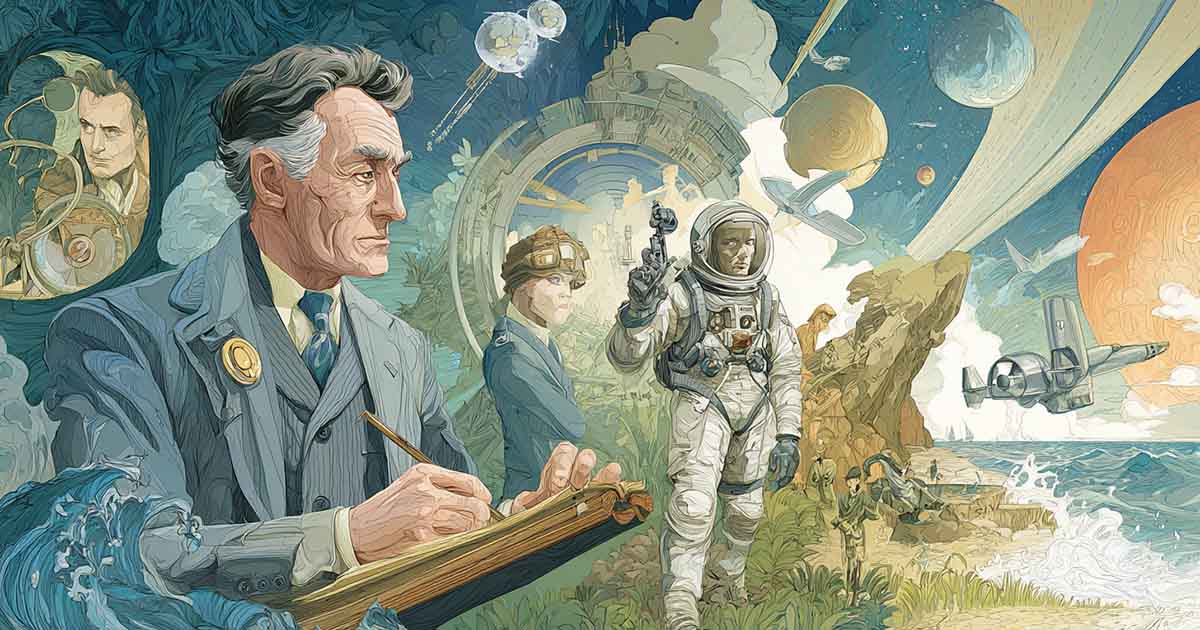
This Week in Classic Science Fiction
"Mysterious Island"
On December 20, 1961, American audiences were introduced to "Mysterious Island," a film that arrived with little noise and stayed with remarkable persistence. Based on the Jules Verne novel, the picture belongs to a confident period of science fiction when adventure, engineering, and moral order moved in the same direction.
Directed by Cy Endfield, the film tells a straightforward story. A group of castaways survives on an uncharted island through discipline, cooperation, and practical intelligence. Science is not mystical here. It is a tool. When problems arise, they are met with reason, patience, and hard work. That approach reflected an early-1960s American belief that knowledge, properly applied, could tame even the most hostile environment.

What most viewers remember, of course, is Ray Harryhausen's stop-motion work. His creatures are not mere spectacle. They represent nature made dangerous when separated from civilization and restraint. The message is clear without being preachy. Man survives not by dominance alone, but by order, restraint, and shared purpose.

"Mysterious Island" also marks a moment when science fiction trusted its audience. It assumes the viewer can follow ideas, appreciate craft, and accept that progress comes with responsibility. In an era before digital shortcuts, the film reminds us that imagination, like civilization itself, is built carefully, piece by piece.
More than sixty years later, it still holds.
Sponsored by: The Last Warlord of Vexis Prime T-shirt

The Last Warlord of Vexis Prime T-shirt captures a familiar science fiction idea. A defeated world, one survivor, and unfinished business. The artwork evokes classic space adventure, where character and consequence mattered more than spectacle.
The Order Beneath the Adventure
Long before rockets dominated the imagination, science fiction was built on quieter assumptions. Jules Verne believed that progress followed order, and that knowledge carried obligation.
His stories did not celebrate chaos or accident. They assumed that a rational man, placed under pressure, would restore balance through discipline and cooperation. This outlook formed the backbone of modern science fiction long before the genre found its visual language.
Verne's engineers and explorers do not conquer the unknown through bravado. They observe, measure, and act with restraint. Nature resists them, but it is not malicious. Survival depends on patience and moral clarity as much as ingenuity. These ideas would travel intact into the twentieth century, even as the settings changed and the machines grew larger.
Verne's America in the Atomic Age
In the years after the Second World War, American science fiction adopted Verne with enthusiasm. The atomic age promised both abundance and annihilation, and audiences looked for reassurance that knowledge still served human ends.
Verne's worldview provided that assurance. Science fiction films of the 1950s and early 1960s treated expertise as a stabilizing force. Competence mattered. Authority was earned through understanding.
Hollywood did not simply adapt Verne's plots. It absorbed his confidence in structure. Engineers replaced explorers. Laboratories replaced workshops. Yet the moral equation remained the same. Order overcame danger when men accepted responsibility for what they built and discovered.
"Mysterious Island" as a Bridge
"Mysterious Island" from 1961 stands at the center of this transition. The film belongs neither fully to the Victorian past nor to the coming space race. Its characters survive through planning, shared labor, and restraint. Technology is present, but it never substitutes for judgment. Science serves life rather than dominating it.
Ray Harryhausen's creatures underscore this balance. They are formidable, but they are not villains. They represent nature unchecked by civilization. The challenge is not destruction but control. This perspective reflects a mature strain of science fiction that trusts limits as much as ambition.
From Islands to the Stars
As science fiction turned toward space, the island simply moved outward. Planets, space stations, and distant colonies functioned as closed worlds where order had to be rebuilt from first principles. The lessons remained unchanged. Survival required cooperation. Knowledge preceded power. Civilization emerged through restraint rather than impulse.
The space age did not erase Verne's influence. It magnified it. Beneath the hardware and spectacle, classic science fiction continued to ask whether men could govern what they created.
Why This Line Still Holds
The strength of this tradition lies in its confidence. It assumes that imagination serves responsibility. "Mysterious Island" reminds us that, in science fiction, progress was once believed to be earned, not granted. That belief gave the genre its lasting authority.
From Verne's pages to mid-century cinema, the line is straight and unbroken. Science fiction at its best prepares the mind not for escape, but for stewardship.
“Mysterious Island” Trivia
- Ray Harryhausen considered the giant crab sequence one of the most technically demanding stop-motion scenes of his career.
- The film was one of the last major American studio productions to adapt Jules Verne before science fiction shifted decisively toward space-based stories.
- Several exterior island scenes were filmed in Spain, continuing a cost-saving production approach common in early 1960s science fiction films.