
"War of the Worlds" Drew on the Riots
In 1926 and 1938, realistic radio dramas convinced listeners that revolution and Martians were real. Here is how “War of the Worlds” helped spark panic twice.

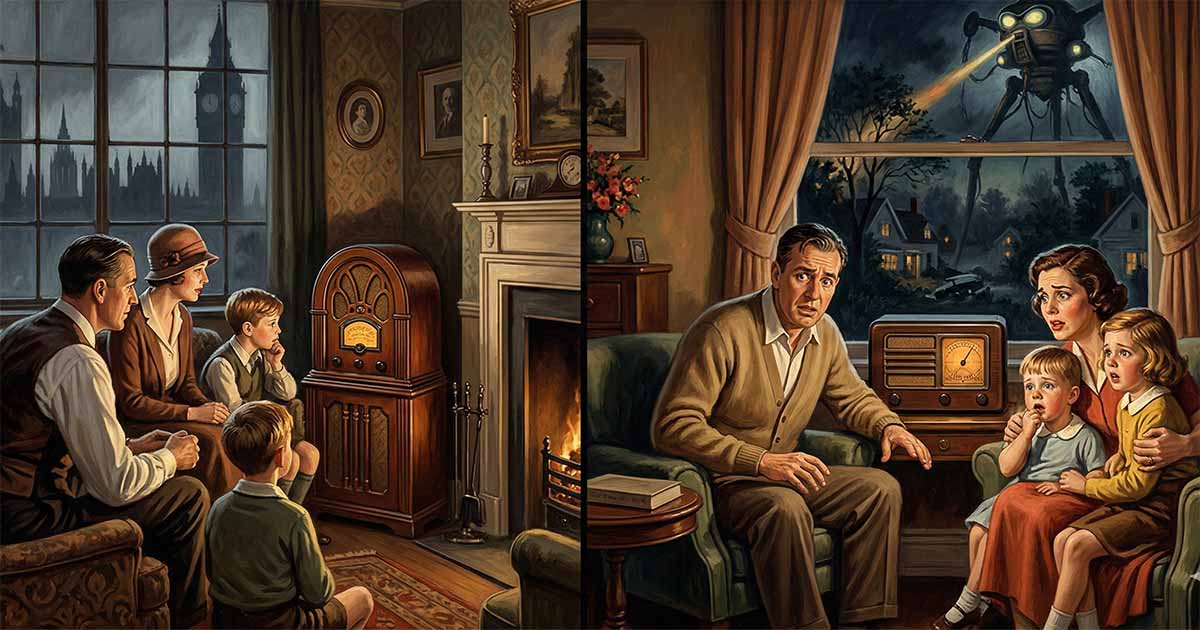
The phrase sounds exaggerated, like one of those legends that grows larger with each retelling. However, history records two separate moments when realistic radio drama unsettled ordinary citizens and blurred the line between fiction and fact. One took place in Britain in 1926. The other erupted in the United States in 1938, when Martians allegedly landed in New Jersey.
The story begins not with aliens, but with revolution.
The London Dress Rehearsal
In January 1926, the BBC broadcast a satirical play titled "Broadcasting the Barricades," written by Father Ronald Knox. The drama described a violent workers' revolt sweeping London, delivered through urgent news bulletins. Landmarks like the National Gallery and the Houses of Parliament reportedly fell to rioters. Explosions echoed through the airwaves as announcers calmly narrated the chaos.
Some listeners tuned in after the introduction and missed the joke. They heard what sounded like sober reporting of a national emergency. Newspapers later described confusion and alarm, and police stations fielded anxious calls. In spite of the satire, the broadcast demonstrated a serious truth about radio's authority.
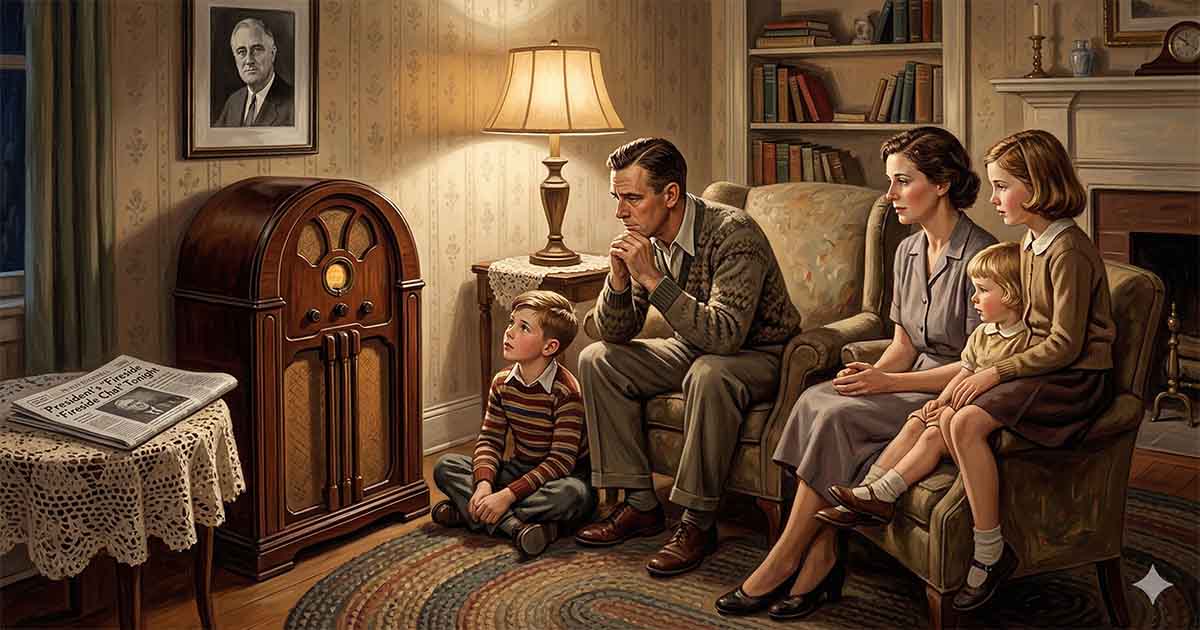
Radio at the time felt immediate and trustworthy. Families arranged their evenings around it. Political leaders spoke through it. When a composed voice described catastrophe, a man tended to believe his ears.
Martians in America
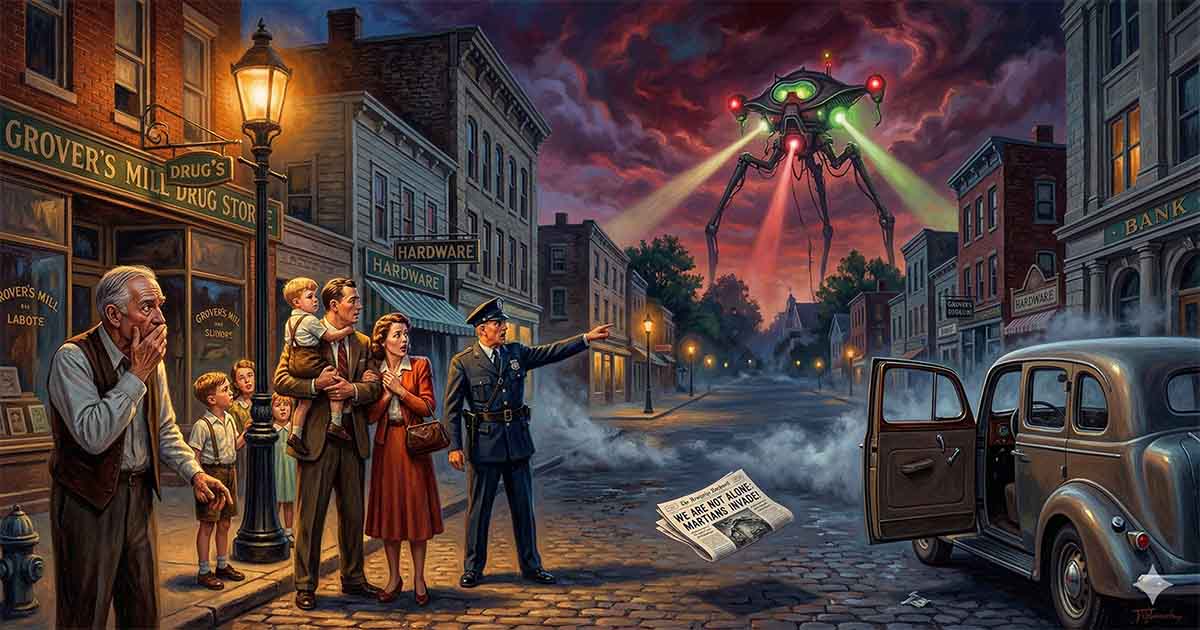
Twelve years later, the technique resurfaced in more dramatic form. On October 30, 1938, Orson Welles and his Mercury Theatre on the Air presented "The War of the Worlds," adapted from H. G. Wells' 1898 novel. The program interrupted dance music with simulated breaking news reports of strange cylinders landing in Grover's Mill, New Jersey. Reporters described heat rays cutting down crowds and black smoke rolling across the countryside.
Listeners who missed the opening disclaimer encountered a convincing sequence of escalating disaster. Military units collapsed. Communications failed. The invasion appeared unstoppable. The realism was so effective that some Americans phoned police, newspapers, and relatives to confirm what was happening.
The next morning, headlines proclaimed nationwide hysteria. Stories spoke of highways clogged with fleeing families and churches filled with frightened worshipers. Later scholarship suggests the panic was less widespread than newspapers claimed, yet documented cases of genuine fear did occur. The legend expanded, but it did not arise from nothing.
Why It Worked
Both incidents relied on the same innovation. They borrowed the language and cadence of live journalism. Instead of narrators and obvious actors, audiences heard correspondents, officials, and eyewitnesses. The familiar structure of breaking news lent credibility to extraordinary claims.
Science fiction supplied the spectacle. Radio supplied the authority. Together, they formed a powerful fusion.
H. G. Wells wrote "The War of the Worlds" as a tale of imperial anxiety and human vulnerability. He imagined what it would feel like for a confident civilization to confront forces beyond its control. When that narrative entered the bloodstream of modern broadcasting, it gained a new dimension. The threat no longer felt distant or literary. It sounded immediate and local.
The Real Invasion
The phrase "War of the Worlds caused panic twice" simplifies the timeline, but it captures a revealing pattern. First came the British experiment that proved realistic bulletins could unsettle a nation. Then came the American adaptation that attached that technique to Martians and made the lesson unforgettable.
In both cases, the deeper issue was trust. Technology advanced quickly. Public skepticism advanced more slowly. That gap allowed fiction, for a few uneasy hours, to pass as fact.
For readers of classic science fiction, the enduring fascination lies there. The Martians never conquered Earth. Yet the broadcasts showed how easily imagination, delivered with authority, can conquer belief.