
World Book Day and the Power of the Written Word in Science Fiction
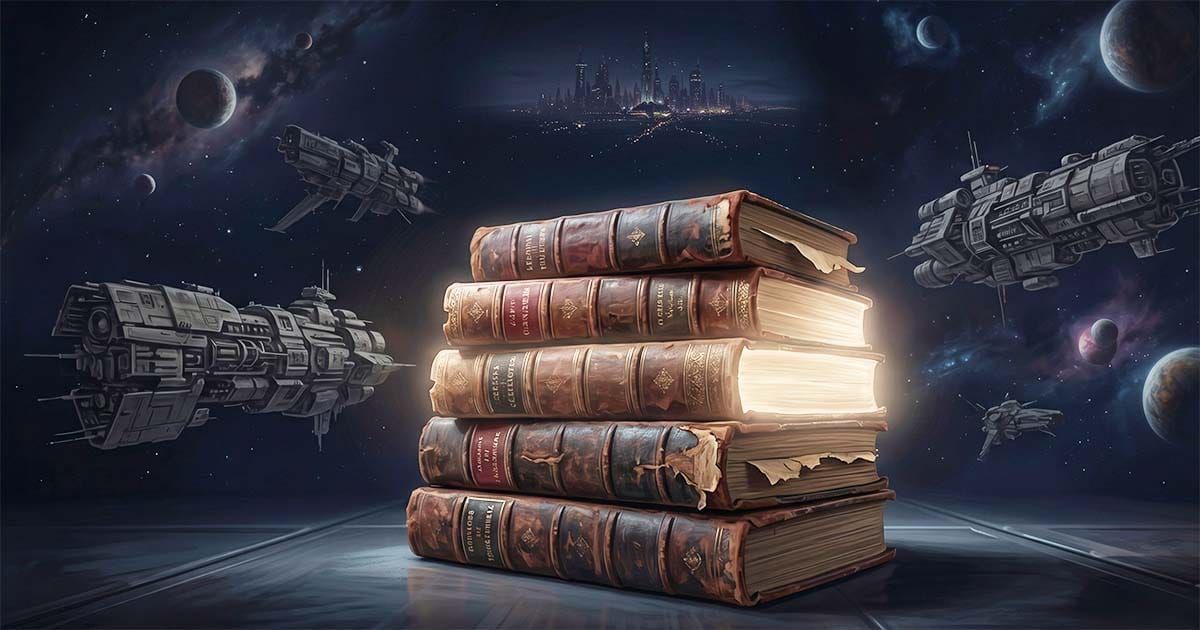
Science fiction shows how books shape civilizations, preserve knowledge, and guide the future. A look at classic works where the written word remains central to survival and progress.

This Week in Classic Science Fiction
April 23, 2026, marks World Book and Copyright Day, a celebration of books and the written word. The day assumes that literature endures, passed from one generation to the next without interruption.
It reflects a modern confidence in preservation, supported by libraries, institutions, and digital archives. Science fiction has long taken a more cautious view. It treats books not as permanent fixtures, but as fragile objects tied to the survival of the societies that produce them.
This concern appears clearly in mid-century works shaped by war and technological change. In Fahrenheit 451, books are outlawed and burned as a matter of public policy, erased not by accident but by collective agreement.
The novel reflects a culture that chooses comfort over thought, and speed over reflection. A few years later, A Canticle for Leibowitz presents a different outcome. After a nuclear war, knowledge survives only in fragments, preserved by a small religious order that copies texts by hand and guards them against a second collapse.
Together, these works reflect a steady assumption within the genre. Knowledge does not endure on its own, and books require deliberate care if they are to survive periods of instability. A day set aside to honor books carries that same implication. What is preserved depends on those willing to protect it.
Sponsored By: The Wedding at Red Meridian Science Fiction T-shirt

The Wedding at Red Meridian
A warlord and his rival stand together beneath twin suns in a rare moment of peace. The design reflects the kind of storytelling long found in classic science fiction, where conflict and duty meet in a single image. Rendered in a bold, cinematic style and printed on a soft, durable shirt.
Books as Foundations of Civilization
Science fiction often concerns itself with advanced machines, distant planets, and speculative futures. Yet beneath these elements lies a quieter constant. Books remain central to how civilizations understand themselves.
World Book and Copyright Day recognizes the importance of the written word, and science fiction reinforces that importance by placing books at the center of cultural survival.
In many works, books are not decorative objects. They serve as foundations upon which societies are built. Records, histories, and texts provide continuity across generations. Without them, knowledge becomes unstable and easily lost. Science fiction treats books as tools that allow a civilization to endure beyond the limits of memory.
Books as Instruments of Power
In "Dune," written texts shape both religion and politics. Manuals, prophecies, and recorded traditions guide entire populations. These texts are studied, interpreted, and applied with precision. Authority flows not only from force, but from control of knowledge preserved in written form.
This pattern appears in other works as well. In "Foundation," knowledge is organized, recorded, and preserved to guide the future of an interstellar civilization.
The effort to collect and maintain information is not passive. It is deliberate and structured. Books and records become instruments through which long-term plans are carried forward.
In both cases, the written word provides stability in uncertain conditions. It allows individuals and institutions to act with purpose. Without reliable records, decisions become reactive and short-sighted. With them, a society gains the ability to think across generations.
Preservation as a Deliberate Act
Science fiction also emphasizes that books endure only when they are preserved with care. In "A Canticle for Leibowitz," knowledge survives because a small group commits itself to protecting and copying texts. Their work is slow and often unrecognized. Yet it provides a bridge between a lost past and a recovering future.
This portrayal reflects a broader truth within the genre. Preservation is not automatic. It requires discipline, attention, and continuity. Books must be maintained, studied, and passed on. When that effort is sustained, knowledge remains available even after periods of disruption.
At the same time, preservation is not limited to formal institutions. Individuals play a role as well. A reader who studies and remembers what he reads participates in that same process. The written word depends on both physical preservation and active engagement.
Books as Guides to Understanding
Beyond preservation, books serve as guides to interpretation and meaning. They provide frameworks through which individuals understand complex realities.
In science fiction, this role often becomes more pronounced as characters face unfamiliar environments and technologies.
Texts offer a way to organize experience. They connect new situations to established knowledge. Without them, each generation would be forced to begin again. With them, progress becomes cumulative. Ideas build upon one another rather than disappearing with time.
This function reinforces the value of reading as an active practice. Books are not static objects. They are tools that shape thought. Their influence depends on how they are used, studied, and applied.
Continuity Across Time
A recurring theme in science fiction is the passage of knowledge across long stretches of time. Civilizations rise and fall, but books provide continuity. They carry forward ideas that might otherwise be lost. This continuity allows later generations to recover what was known before.
In "Foundation," this idea takes a structured form. Knowledge is preserved in anticipation of decline, with the expectation that it will guide future rebuilding. The effort reflects confidence in the durability of written records when they are properly maintained.
This concept appears in different forms across the genre. Whether through formal archives or individual efforts, books serve as links between past and future. They allow a civilization to retain its identity even as circumstances change.
The Enduring Role of the Written Word
Science fiction does not treat books as relics of a simpler age. It presents them as enduring tools that remain relevant even in advanced societies. Technology may change the form of communication, but the underlying need for recorded knowledge persists.
Books provide structure, clarity, and continuity. They support decision making, preserve history, and guide interpretation. Their value does not diminish as societies advance. If anything, it becomes more apparent as the complexity of those societies increases.
The genre's consistent return to this idea reflects a clear understanding. Progress depends not only on innovation, but on the preservation and use of existing knowledge. Books make that process possible.
Classic Works and the Written Word
Several classic works illustrate how science fiction treats the written word as a tool of preservation, authority, and continuity. These books approach the subject from different angles, but each places lasting importance on recorded knowledge.
| Book | Author | Year | Role of the Written Word |
|---|---|---|---|
| "Fahrenheit 451" | Ray Bradbury | 1953 | Books as suppressed knowledge |
| "A Canticle for Leibowitz" | Walter M. Miller Jr. | 1959 | Books preserved after collapse |
| "Foundation" | Isaac Asimov | 1951 | Knowledge organized to guide the future |
| "Dune" | Frank Herbert | 1965 | Texts shaping religion and politics |
| "Brave New World" | Aldous Huxley | 1932 | Books neglected in favor of comfort |
| "Do Androids Dream of Electric Sheep?" | Philip K. Dick | 1968 | Knowledge weakened by uncertainty |
The Quiet Strength of Books
The written word holds a central place in science fiction because it holds a central place in civilization itself. Books shape belief, guide action, and preserve knowledge across generations. They do not endure by accident. They endure through use, study, and care.
A future that values knowledge will continue to rely on books in one form or another. Science fiction presents that future with clarity. The tools may evolve, but the function remains the same. The written word carries the ideas that allow a society to understand itself and move forward.
Classic Science Fiction Trivia
- Ray Bradbury wrote much of "Fahrenheit 451" on a rented typewriter in a library basement, paying by the hour.
- "A Canticle for Leibowitz" was inspired in part by the preservation of knowledge by monks during the Middle Ages.
- Isaac Asimov originally published the "Foundation" stories as a series in magazines before they were collected into a book.
- The fictional texts in "Dune" were modeled on historical and religious writings.
- Philip K. Dick based "Do Androids Dream of Electric Sheep?" on his interest in memory, identity, and what defines human experience.