
Melange, The Spice And The Power Behind Dune
Melange, the spice of Dune, extends life, enables space travel, and drives empire-wide power. Learn how it works, who depends on it, and why it remains essential to the story.


"Melange, The Spice"
Melange, known simply as the Spice, is the most important substance in "Dune." It extends life, improves health, sharpens awareness, and, in some users, unlocks prescience. Just as important, it makes safe interstellar travel possible. That single function alone places it at the center of civilization.
The familiar summary is easy to remember. The Spice extends life. The Spice expands consciousness. The Spice is vital to space travel.
But that summary leaves out the real story. Melange is not simply a drug or a valuable commodity. It is the foundation of a system that binds politics, economics, and survival together. Every major institution depends on it, and no one can replace it. That is what gives Spice its true weight.
Melange, The Spice — Character Dossier
| FIELD | DETAILS |
|---|---|
| Name | Melange |
| Aliases | The Spice, Spice Melange |
| Affiliation | Arrakis; controlled by Imperial powers, CHOAM, and the Spacing Guild |
| First Appearance | "Dune" by Frank Herbert, 1965 |
| Portrayed In Film By | Visualized as a substance in "Dune" (1984) and "Dune" (2021) |
| Portrayed In Miniseries By | Depicted in "Frank Herbert's Dune" (2000) and its sequel |
| Role | Essential resource enabling space travel, extending life, and driving political and economic power across the Imperium |
| Description | A rare, cinnamon-scented orange-brown substance found only on Arrakis. Melange enhances awareness, prolongs life, and enables prescience in certain users while creating absolute dependence |
Origins And Context
Melange originates on Arrakis and nowhere else. That fact shapes everything that follows.
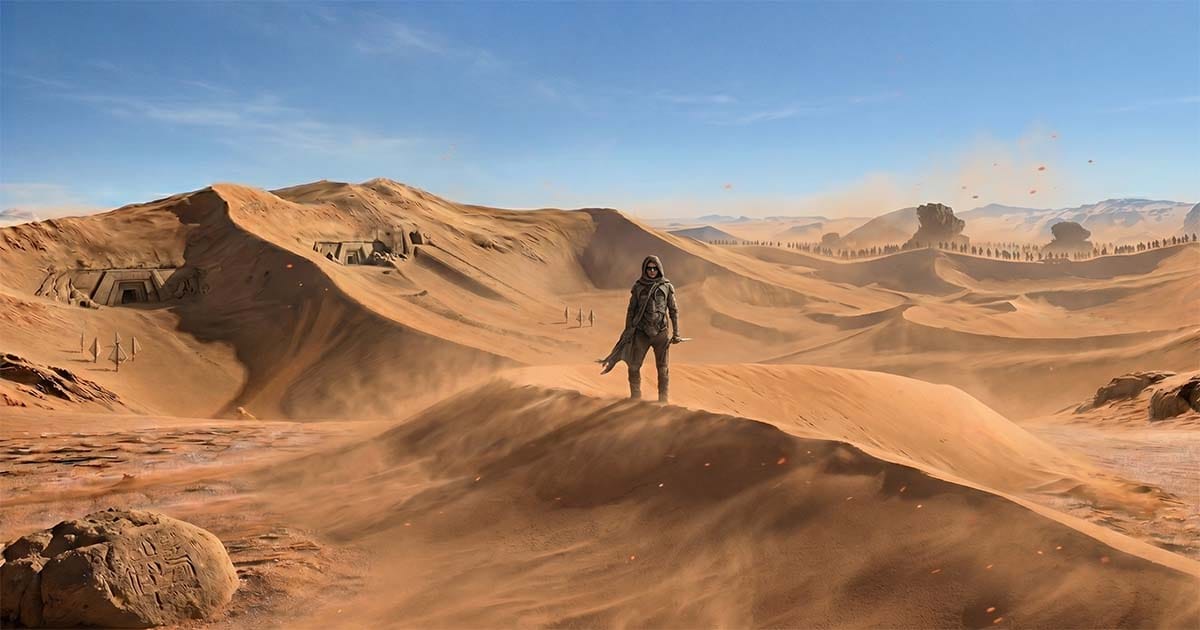
Arrakis is a desert world defined by scarcity. Water is rare, the environment is hostile, and survival requires discipline. Spice is not imported into this system. It emerges from it. The substance forms through a natural cycle tied to the sandworms and the deep desert. Beneath the surface, chemical processes build pressure until a pre-spice mass erupts. Once exposed to heat and air, it becomes melange.

In the first novel, this cycle is not fully explained. Herbert gives the reader enough information to understand that Spice is dangerous to harvest and impossible to duplicate. Later material fills in the biological details, but the core idea is already present. Spice is not just rare. It is locked to a specific ecology.
This is a deliberate choice. By tying the most valuable substance in the universe to a single fragile environment, Herbert creates a built-in limit. The empire may span worlds, but it depends on one.
What Melange Does
Melange produces a range of effects, and those effects scale with exposure and training.
At the basic level, Spice extends lifespan and improves overall health. Users remain active longer, think more clearly, and maintain physical resilience. This alone would justify its value.

At higher levels, the mental effects deepen. Awareness sharpens into something more precise. Patterns become visible. Decisions can be made with unusual confidence. At the extreme edge, this becomes prescience, the ability to perceive possible futures.
There is also a cost. Melange is highly addictive. Once the body adapts to it, withdrawal is fatal. This ensures that dependence is permanent.
The effects vary by group:
Fremen live with constant exposure. Over time, their bodies adapt. Their eyes turn blue, and their perception of the desert becomes exact. They do not simply survive Arrakis. They understand it.
The Bene Gesserit use Spice with control. Through ritual, they expand awareness and access deeper layers of memory. Their use is deliberate, not excessive.
The Spacing Guild depends on extreme exposure. Guild Navigators undergo physical transformation, but gain the ability to guide ships through folded space. Without this ability, interstellar travel becomes guesswork, and guesswork is not acceptable at that scale.
Paul Atreides represents a different case. In the first novel, Spice amplifies his abilities beyond known limits. His awareness expands rapidly, and his perception of time begins to change. This is where the narrative begins to shift from political drama to something larger.
The key point is simple. Spice does not create ability from nothing. It magnifies what is already present.

Spice And Power
The importance of Spice comes from its place in a larger structure.
Arrakis produces melange.
Melange enables Guild navigation.
Guild navigation allows safe travel between stars.
Travel supports trade, communication, and political control.
Remove any part of that chain, and the system fails.
Because Spice exists only on Arrakis, control of that planet becomes the central political concern. Noble houses compete for access. The Emperor regulates its flow. Commerce depends on stability in production.
This creates a single point of dependence. An empire that appears vast and secure is, in fact, fragile. It rests on one resource, in one location, under constant pressure.
That is the underlying tension. Power in "Dune" is never fully secure because it is always tied to something that cannot be expanded or replaced.
Role In The Story
Melange drives the events of "Dune" from the beginning.
House Atreides is sent to Arrakis because spice production must be maintained. House Harkonnen resists because Spice is the source of its wealth. The Emperor intervenes because control of Spice determines the balance of power.
These actions are not random. They follow directly from the structure of dependence.
At the same time, Spice shapes individual paths. As Paul's exposure increases, so does his awareness. What begins as a political assignment becomes a turning point. His understanding expands, and the consequences extend beyond the immediate conflict.
Spice operates on both levels at once. It drives large-scale political decisions and personal transformation. That dual role gives it unusual weight in the narrative.

Why Confusion Persists
Confusion about melange comes from the way information is presented.
Some explanations simplify the concept into a short list of effects. Others include details from later books without separating them from the first novel. Film adaptations add another layer by changing how Spice looks and behaves on screen.
When these versions are combined, the result is a blurred picture.
A clear explanation separates three things. What Spice does at a basic level. How different groups use it. What is established in the first novel versus what comes later. Once those lines are drawn, the concept becomes easier to follow.
Closing Reflection
Melange offers life, clarity, and power. At the same time, it binds every user to a single, fragile source. That balance is not a flaw in the story. It is the point.
"Dune" endures because it understands that power always carries a cost.