
“Hyperion” and the Return of the Big Science-Fiction Novel
Dan Simmons’ “Hyperion” remains a science-fiction classic through literary ambition, imaginative scale, and a lasting focus on memory, meaning, and human experience.


Science fiction in the late twentieth century developed a growing confidence in its own scale. Writers expanded their settings, lengthened their timelines, and built elaborate visions of humanity's future. Those ambitions produced memorable work, but they also revealed a recurring weakness.
Large speculative fiction sometimes became more impressed with invented systems than with the people expected to live inside them. Dan Simmons' "Hyperion," published in 1989, pursued a better balance. The novel embraces the breadth of major science fiction while refusing to treat size as a substitute for significance.
That choice helps explain why "Hyperion" still holds an unusual place among modern science-fiction classics. Its reputation rests on ambition, but ambition alone does not account for its endurance. Simmons combines literary seriousness with readability and treats speculative ideas as extensions of recognizable experience.
Questions of memory, responsibility, belief, and personal meaning remain visible beneath the scale of the setting. Readers do not need to approach "Hyperion" as a monument to genre prestige in order to appreciate it. They need only accept the novel's central assumption that the future becomes interesting when it reveals something enduring about human life.
A Journey Instead of an Adventure
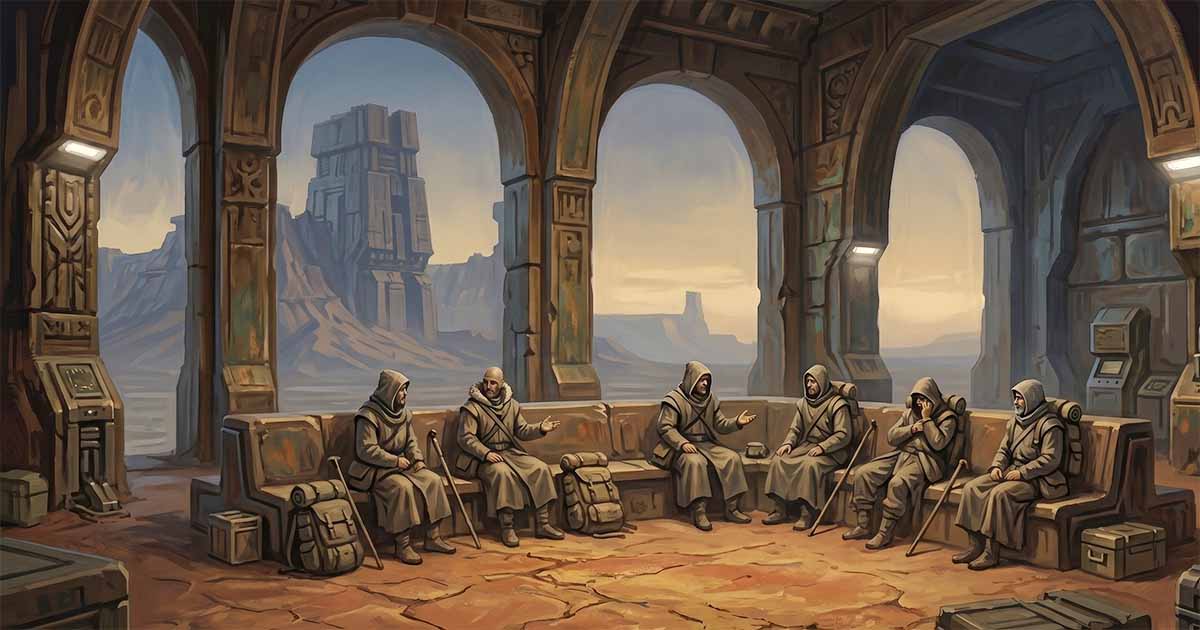
The structure of "Hyperion" immediately separates it from more familiar forms of large-scale science fiction. Rather than sending a hero outward to conquer territory or solve a sequence of external problems, Simmons gathers a small group of travelers moving toward a destination already surrounded by expectation and meaning.
This framework changes the reader's relationship to the story from the opening pages because the central question becomes not what waits at the end of the journey, but why each traveler has chosen to undertake it. The result is a novel that values reflection and perspective as much as movement across space.
By choosing a pilgrimage instead of an expedition, Simmons shifts attention away from conquest and discovery. The future remains expansive, but it becomes a setting for personal examination rather than achievement. Readers are encouraged to think about motive, memory, and belief before considering outcomes. That choice gives the novel a more contemplative atmosphere than many works operating on a similar scale.
This structure also changes the rhythm of the reading experience. Conventional space opera often creates momentum through escalating action and increasingly visible conflict. "Hyperion" advances differently, placing greater trust in conversation, recollection, and gradual understanding. Information appears through experience and carries emotional meaning rather than arriving as detached explanation.
Movement in the novel comes through interpretation as much as event. As travelers explain themselves and respond to one another, the world expands in ways that feel personal rather than mechanical. Readers gain understanding by comparing perspectives instead of collecting facts. Simmons creates suspense not by constantly increasing the size of events, but by deepening the reader's understanding of the people moving through them.

Seven Voices and One World
The pilgrimage structure would not work without strong variation in perspective, and Simmons understands this from the beginning. Each traveler brings a different way of understanding experience, and those differences shape the reader's view of the world as much as the events themselves.
The changing voices create variation in tone and scale while revealing that no single person possesses a complete understanding of the society surrounding him. Some perspectives emphasize responsibility while others emphasize uncertainty, ambition, or reflection.
Simmons uses these differences to create movement inside a story that might otherwise feel static. Instead of presenting one authoritative account of the future, he allows competing assumptions to exist beside one another.
This approach also prevents the novel from becoming repetitive. The reader never remains in one emotional register long enough for the structure to become predictable. Each transition changes not only what the reader learns, but how the reader evaluates what has already been presented. That process gives the novel an unusual sense of depth because understanding grows through comparison rather than accumulation alone.
The use of multiple perspectives also shapes the worldbuilding. Simmons rarely stops to explain the setting directly and instead allows history, technology, and culture to emerge through observation and memory. Readers encounter institutions because people depend on them and encounter historical events because those events continue shaping private lives. The effect is less like receiving a guided tour and more like entering an established society where everyone already understands the rules.
That method creates immersion because the future never appears as a collection of concepts waiting to be admired. Technology remains present, but it is treated as part of ordinary life rather than as spectacle. Cultural details appear naturally through conversation and personal experience. Simmons trusts readers to assemble meaning gradually, and that confidence makes the world feel inhabited instead of constructed.
Big Ideas With Human Weight
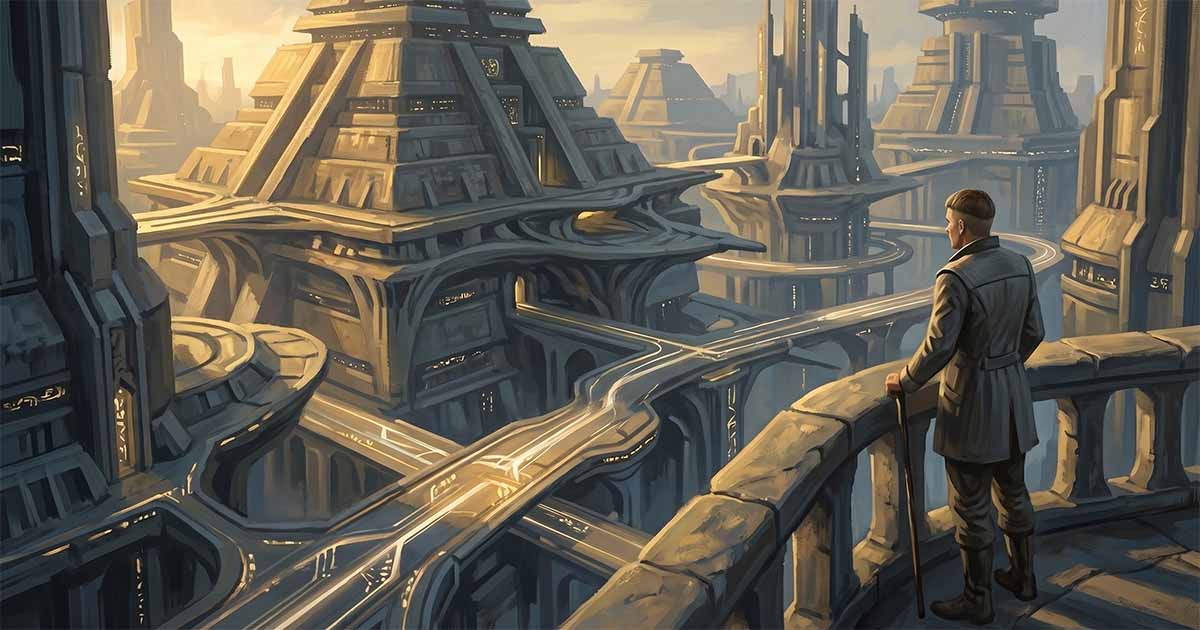
One of the reasons "Hyperion" feels more substantial than many large science-fiction novels is its treatment of time. Simmons shows little interest in presenting time as a technical puzzle to be solved or admired. Instead, time becomes a source of emotional and philosophical pressure that shapes how people understand themselves and their lives.
Characters think about change, memory, expectation, and the limits placed on human experience by forces they cannot fully control. This approach gives the novel unusual weight because speculative ideas remain connected to recognizable concerns. The future may alter the scale of life, but it does not remove uncertainty or make human choices easier.
Simmons uses this concern with time to create a broader sense of seriousness throughout the novel. Moments gain importance because they feel temporary and because people understand them imperfectly while living through them. The novel repeatedly suggests that advancement does not free humanity from difficult questions about meaning or consequence. Instead, those questions become more visible when placed against a larger historical and technological background.
The treatment of technology follows the same principle. "Hyperion" does not present the future as an exhibition of inventions or a celebration of progress. Technology appears as part of ordinary life and matters because it changes the conditions under which people make decisions. Readers encounter systems, institutions, and capabilities through the experiences of those living among them rather than through detached explanation.
That choice keeps the novel grounded even when its scale becomes enormous. Civilization in "Hyperion" functions less as an object of admiration than as an environment that reveals priorities, values, and limitations. Simmons remains interested in consequences more than novelty and in how people adapt to conditions they did not create. The result is a future that feels inhabited rather than theoretical and imaginative, without becoming emotionally distant.
Mystery and Meaning
For all of its speculative scale, "Hyperion" returns repeatedly to concerns that remain familiar regardless of setting. Memory becomes more than recollection and begins to shape identity and responsibility. Obligation appears not as a duty imposed from outside, but as something characters carry into difficult circumstances and interpret for themselves.
Ambition appears in several forms and is rarely treated as entirely admirable or entirely destructive. Simmons enlarges these concerns by placing them inside a future of extraordinary reach, yet he never allows them to become abstract. The speculative setting broadens the questions while preserving their human scale, which gives the novel emotional continuity across its changing voices and settings.
This emphasis helps explain why the novel feels more reflective than many works operating at a similar scale. Readers are invited to think about meaning rather than simply absorb information. Even when the book introduces unfamiliar ideas, it remains anchored in recognizable experiences of hope, uncertainty, and personal consequence. That restraint keeps the novel from becoming emotionally remote.
Simmons shows similar restraint in his treatment of mystery. Many science-fiction novels eventually explain every unusual event and reduce uncertainty to information. "Hyperion" follows another tradition and allows some questions to remain open long enough to preserve atmosphere and tension. The unknown remains powerful because characters respond to it before they understand it.
That approach gives the novel a quality that rewards rereading. Once readers know the broad movement of the narrative, attention shifts toward how details are revealed and how meaning changes through perspective. Simmons provides enough structure to create satisfaction while preserving enough uncertainty to sustain curiosity. The result is a novel that continues inviting interpretation after its immediate surprises have faded.

A Classic That Earns Its Size
Ambition rarely arrives without tradeoffs, and "Hyperion" provides several. The structure that gives the novel distinction also creates unevenness because readers will almost certainly respond more strongly to some voices than others.
Certain sections create immediate investment while others ask for more patience and reflection. That unevenness becomes part of the reading experience and reflects the risks Simmons accepts in constructing the novel through multiple perspectives.
The pacing creates another challenge. "Hyperion" often slows down to develop atmosphere, ideas, and relationships instead of pushing continuously toward immediate resolution. Simmons expects readers to follow shifts in tone and perspective without constant guidance. Yet these demands feel less like errors than consequences of the novel's larger ambitions.
A more streamlined version of "Hyperion" might have moved faster and satisfied readers looking for a simpler adventure. It also would have sacrificed much of the depth and atmosphere that continue to distinguish the book decades after publication.
Simmons attempts to expand what a large science-fiction novel can accomplish while preserving the pleasures that make the genre attractive in the first place. The novel never abandons imagination in pursuit of seriousness and never abandons readability in pursuit of scale.
That balance explains why "Hyperion" remains influential rather than merely respected. Its speculative ambition never overwhelms character, emotion, or recognizable human concerns.
The future remains impressive because people still matter inside it. More than three decades after publication, the novel continues to reward readers not because it offers escape from ordinary life, but because it uses extraordinary circumstances to return readers to enduring questions about how people live, remember, choose, and understand the world around them.