
Baseline Test in "Blade Runner 2049" Explained
The Baseline Test in "Blade Runner 2049" measures replicant stability, obedience, and identity through one of the sequel's most haunting rituals.


The Baseline Test is a psychological examination featured in "Blade Runner 2049" (2017). The test is administered to Nexus-9 replicants after active duty to confirm that they remain emotionally stable, obedient, and mentally fit for service. Although it appears to be a routine evaluation, the test becomes one of the film's most important symbols of identity, authority, and control.
Unlike the Voight-Kampff test from "Blade Runner" (1982), the Baseline Test does not determine whether someone is human or replicant. The subject's identity is already known. The examination instead measures whether a replicant continues to function within the narrow psychological limits established by his creators.

How the Baseline Test Works
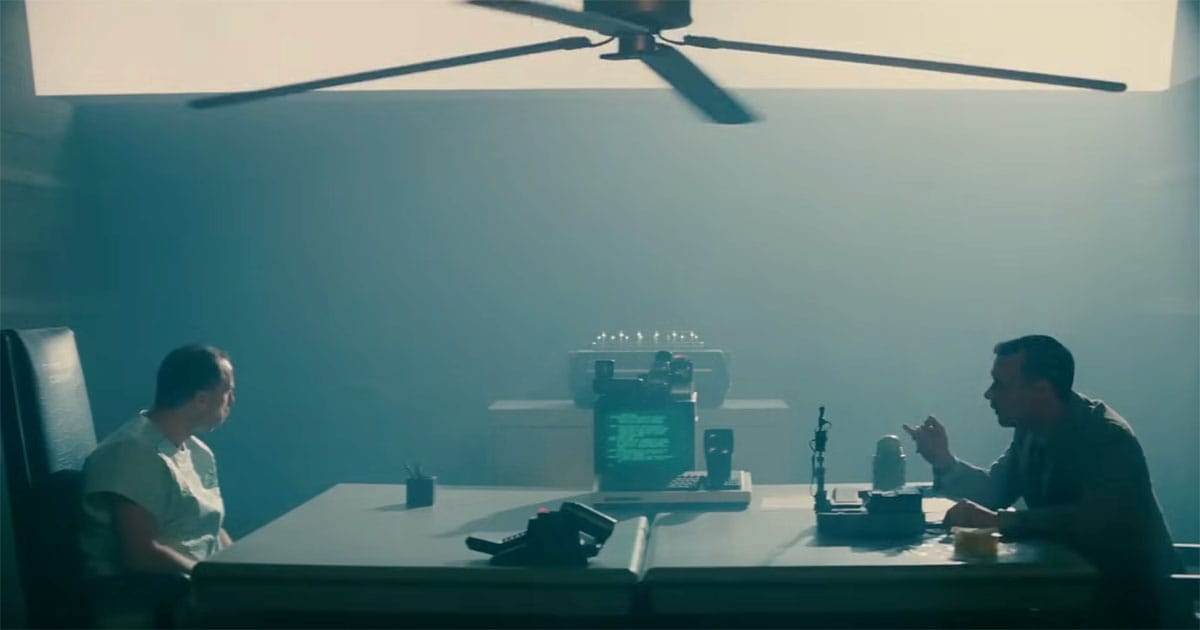
The examination takes the form of a rapid verbal exchange between an examiner and the replicant. The examiner recites a series of scripted phrases, and the subject must respond with precise words, perfect timing, and complete emotional neutrality. Any hesitation, change in tone, or visible emotional reaction suggests that the replicant has drifted from his established baseline.
Several of the test's best-known phrases include "Cells" and "Interlinked." The dialogue also incorporates lines adapted from Vladimir Nabokov's novel "Pale Fire." The film never explains why these words were selected, which gives the examination an unsettling quality and encourages viewers to focus on the subject's reactions rather than the language itself.
The procedure is identified as a post-trauma baseline test, which suggests that it follows stressful or emotionally demanding assignments. Exactly how the examination measures psychological stability is never explained. That ambiguity reinforces the film's larger interest in the hidden workings of power and authority.

Purpose in "Blade Runner 2049"
The Baseline Test exists to preserve obedience. Replicants perform dangerous work on behalf of human society, and the authorities expect them to carry out every assignment without allowing personal feelings to influence their decisions.
The examination does not measure intelligence or technical ability. It measures consistency, discipline, and emotional control. A successful replicant repeats the required responses without revealing uncertainty, fear, curiosity, or personal attachment.
The test also reveals how little freedom replicants possess. They are monitored long after they leave the field, and even their private thoughts become subjects for official inspection. The examination reminds the audience that the greatest form of control is often psychological rather than physical.

K's Failing Baseline
The Baseline Test plays a central role in the story of K, a Nexus-9 blade runner employed by the Los Angeles Police Department. Early in the film, he completes the examination with flawless precision. His performance confirms that he remains exactly what the system expects him to be.
As K investigates the mystery surrounding a replicant child, his understanding of himself begins to change. He develops emotional attachments, questions his memories, and begins making decisions based on personal conviction rather than simple obedience. Those experiences gradually separate him from the rigid psychological condition the Baseline Test is designed to confirm.
When K later struggles to complete the examination, the moment marks a turning point in the story. His failure does not suggest that he is malfunctioning. Instead, it reveals that he has begun to develop an independent identity that cannot be measured or controlled through routine psychological conditioning.

Comparison with the Voight-Kampff Test
The Baseline Test serves as a successor to the Voight-Kampff examination introduced in "Blade Runner." Both tests evaluate emotional responses, yet they pursue different objectives within the story.
The Voight-Kampff test attempts to identify replicants by measuring emotional reactions associated with empathy. The Baseline Test assumes that the subject is already known to be a replicant. Its purpose is to verify that he remains psychologically compliant after experiencing the challenges of everyday life.
That distinction reflects the changing focus of the two films. "Blade Runner" asks whether humans and replicants can truly be distinguished from one another. "Blade Runner 2049" asks whether a being capable of memory, loyalty, sacrifice, and love can continue to exist as property once he develops a genuine sense of self.
Legacy
The Baseline Test has become one of the most memorable ideas introduced by "Blade Runner 2049." Its haunting dialogue and ritualized structure give the film some of its most unforgettable scenes. Fans continue to quote its distinctive phrases because they capture the unsettling atmosphere that defines the sequel.
More important, the examination gives visual form to one of the film's central themes. The greatest threat facing K is not violence or mechanical failure. It is the possibility that his own thoughts and emotions might lead him beyond the limits imposed by those who created him.