
H. G. Wells Helped Create Modern Science Fiction
Born September 21, 1866, H. G. Wells helped shape modern science fiction. Discover how his time machines, alien invaders, strange experiments, and bold ideas transformed the genre.


This Week in Classic Science Fiction
On September 21, 1866, Herbert George Wells was born in Bromley, England. He would become one of the writers who helped establish science fiction as a recognizable form of literature.
Wells produced a remarkable succession of novels in the 1890s. "The Time Machine" appeared in 1895, followed by "The Island of Doctor Moreau" in 1896, "The Invisible Man" in 1897, and "The War of the Worlds" in 1898.
In only four years, Wells explored ideas that would occupy science fiction for the next century. His stories featured travel through time, the alteration of living creatures, invisibility achieved through science, and an invasion of Earth by technologically superior aliens.
Those ideas became so familiar that it is easy to forget how unusual they were when Wells wrote about them. His stories inspired generations of writers and repeatedly made their way to movies, radio, and television.
Wells died in 1946, but the future he imagined outlived him. September 21 marks the birth of a writer whose strange machines, alien invaders, and dangerous experiments helped give modern science fiction much of its imagination.
Sponsored by: The Spore Cathedral T-shirt

The Spore Cathedral T-shirt
Somewhere beneath a violet sky, something enormous has taken root. The Spore Cathedral T-shirt captures the mystery of classic science fiction with a colossal alien fungus towering over two explorers. It is a strange world, an impossible discovery, and exactly the sort of place a science-fiction reader wants to visit from a safe distance.
What H. G. Wells Gave Science Fiction
H. G. Wells wrote about time machines, invisible men, alien invaders, strange creatures, and voyages to the Moon before any of them became standard science-fiction material. His extraordinary imagination explains part of his influence, but simply counting his inventions misses what made Wells important.
Wells gave later writers a way to construct science fiction. He began with an extraordinary scientific possibility, treated it seriously, and followed the consequences wherever they led. That approach helped establish a blueprint the genre has followed ever since.

Science Became the Engine
Fantastic literature existed long before Wells. Men traveled to imaginary lands, encountered strange creatures, and experienced impossible events, but magic, dreams, and unexplained wonders often made those adventures possible.
Wells tried something different. The traveler in "The Time Machine" built a machine, Griffin in "The Invisible Man" discovered a scientific method for making himself invisible, and Doctor Moreau used surgery and biological experimentation to transform animals. In "The First Men in the Moon," Cavor invented an extraordinary material called Cavorite to reach the Moon.
The explanations were fictional, but that was not the point. Wells asked the reader to accept one scientific impossibility and then treated what followed as reality. Science did not decorate his stories. Science made the stories happen.

Discovery Had Consequences
Wells was fascinated by scientific discovery, but he rarely treated a breakthrough as the happy ending. Discovery was usually where the trouble started.
Griffin succeeded in becoming invisible, but the achievement did not make his life better. Clothing revealed him, cold weather tormented him, ordinary social life became difficult, and his newfound power encouraged his worst impulses. Wells took what sounded like a marvelous ability and considered what possessing it might actually mean.
Doctor Moreau presented an even darker case. His ability to alter living creatures demonstrated technical brilliance without demonstrating wisdom. Wells separated two questions that science fiction would ask repeatedly throughout the next century. What can man do, and what should man do?
That distinction became one of the genre's great themes. New technology could improve life, but Wells understood that greater power did not automatically produce better men.
The Future Became a Laboratory
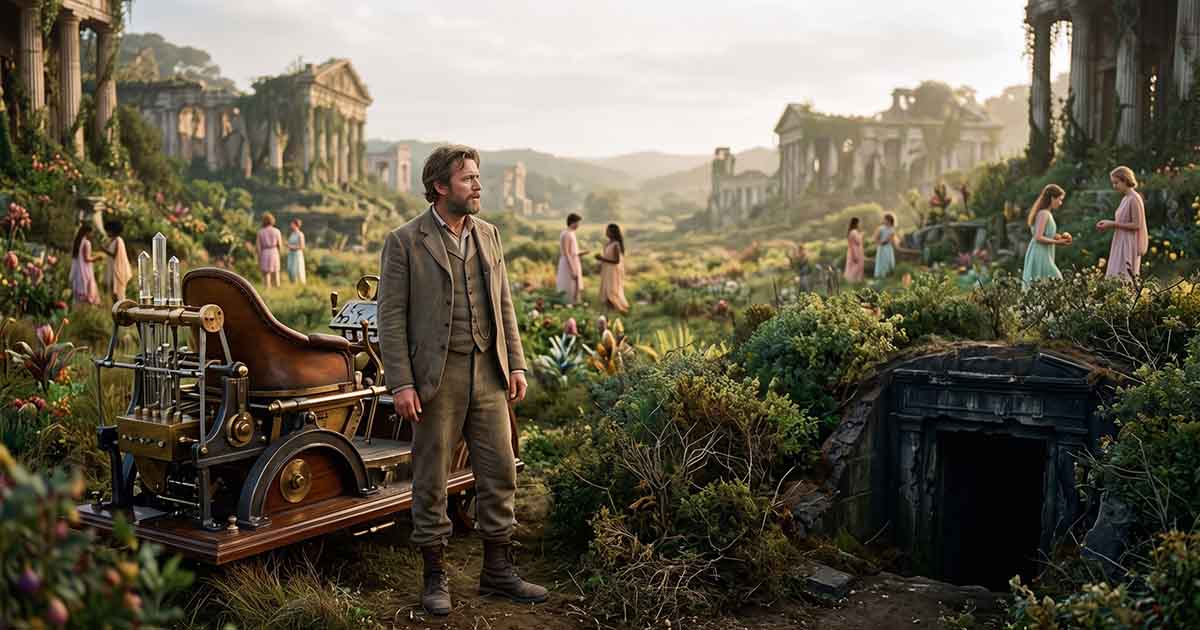
"The Time Machine" could have been a story about the marvelous experience of traveling through history. Wells instead sent his traveler forward to the year 802,701, where he found the Eloi and Morlocks.
These two radically different creatures were descendants of humanity. The beautiful Eloi lived an apparently carefree existence above ground, while the Morlocks inhabited the darkness below. The distant future allowed Wells to imagine humanity itself becoming something almost unrecognizable.
The important invention was therefore not merely the machine. Wells used the machine to change the reader's perspective, making contemporary civilization appear temporary rather than permanent.
That approach became fundamental to science fiction. A writer could move centuries ahead, change the conditions of human existence, and ask what remained. The future became a laboratory where ideas about civilization, technology, and human nature could be tested.
Humanity Lost Its Pedestal
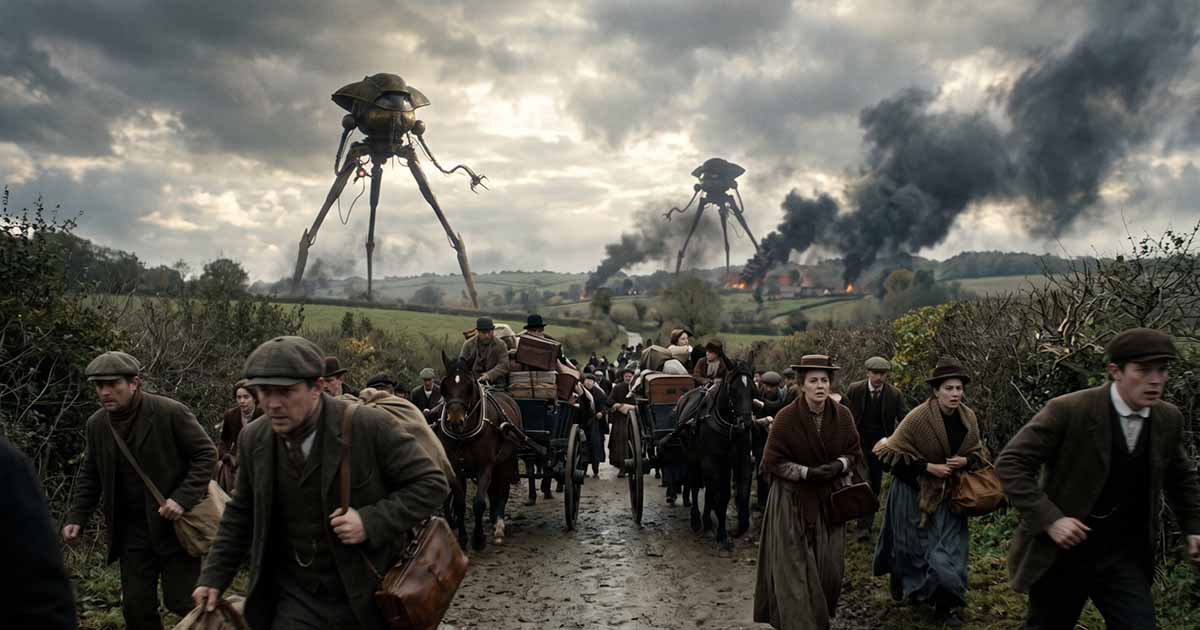
Wells also had a habit of reminding mankind that it might not occupy the most important position in creation. "The War of the Worlds" did this with particular force.
The Martians possessed weapons against which human forces could offer little effective resistance. People who had considered themselves masters of their world suddenly became frightened creatures fleeing something vastly more powerful. Human civilization looked considerably less impressive when confronted by a superior civilization.
The ending made the reversal even sharper. Human ingenuity did not defeat the Martians. Terrestrial microorganisms killed them because the invaders lacked resistance to Earth's microscopic life.
"The First Men in the Moon" pushed the idea in another direction. The travelers did not find an empty world waiting for men to claim it. They discovered the Selenites, inhabitants of an organized civilization with its own social structure.
Wells made the universe larger while making humanity smaller. Science fiction would return to that perspective whenever aliens, distant planets, or future civilizations forced mankind to see itself from the outside.
Wells Left a Blueprint
Wells did not invent every concept associated with his stories. Speculative voyages, imaginary worlds, strange inventions, and stories about other forms of life existed before him. His achievement was more important than simply being first.
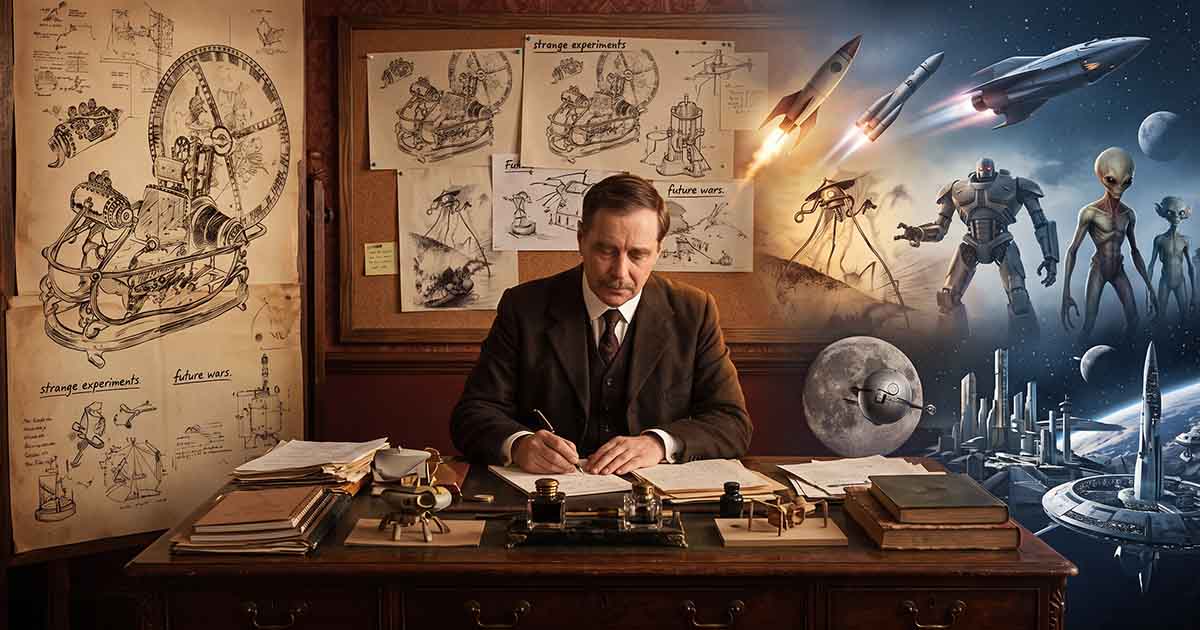
Wells demonstrated how scientific speculation could become the foundation for serious storytelling. He could introduce one extraordinary possibility and then ask what it would do to a man, a civilization, or even the entire human species. The invention attracted the reader, but the consequences gave the story its weight.
That method survived long after Wells's Victorian machinery became antique. Twentieth-century science fiction changed the rockets, robots, laboratories, computers, and aliens, but its writers repeatedly returned to questions Wells had demonstrated so effectively.
What happens if the invention actually works, and what happens when scientific ability outruns human wisdom? What happens when mankind encounters something greater than itself? Those questions became central to science fiction because they turn speculation into something more substantial than an adventure.
That may be H. G. Wells's greatest contribution to the genre. He gave science fiction more than a collection of remarkable ideas. He showed generations of writers how scientific speculation could reveal something about man and his place in the universe.
H.G. Wells Trivia
- Wells taught A. A. Milne, the future creator of Winnie-the-Pooh, while working as a schoolteacher.
- Before “The Time Machine,” Wells wrote an earlier time-travel story called “The Chronic Argonauts” in 1888.
- Wells’s first books were not science fiction. In 1893, he published a biology textbook and co-authored a book on physiography.