
Taming the Wasteland
Science fiction’s harshest desert worlds reveal ingenious survival technologies, from Dune’s stillsuits and Tatooine’s moisture farms to planetary engineering in Aliens and the Mars Trilogy.

How Science Fiction Conquers the Extreme Desert
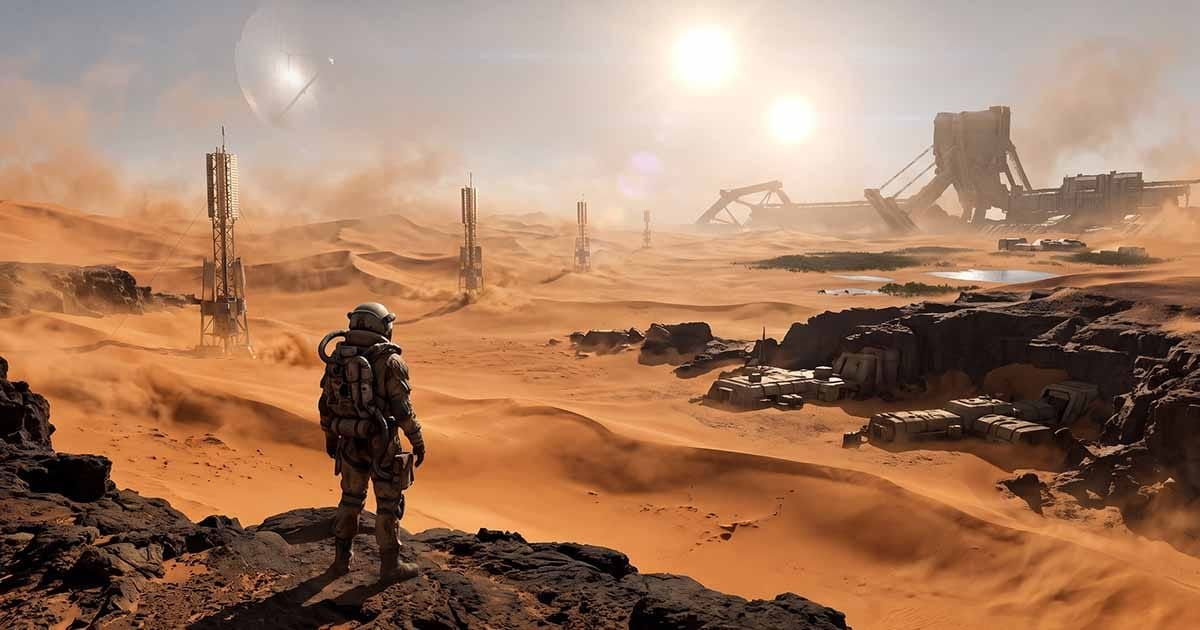
In the grand tapestry of speculative fiction, the desert is never just a backdrop—it is an apex predator. Hyper-arid wildernesses do not merely challenge wayfarers. They wage unrelenting war against biology itself. Naturally, humanity's immediate response upon discovering an inhospitable, sun-baked planetary skillet is: "Let's build a suburb here." Step outside unprepared, and an extreme sci-fi desert will strip the moisture from your tissues cell by agonizing cell, grind titanium alloys into powdery slag with micro-pulverized silicate, and mercilessly enforce the cold, unyielding laws of thermodynamics against any civilization bold enough to challenge its sovereignty. From the sun-bleached erg oceans of Arrakis to the radiation-scoured rust flats of post-collapse Earth, these hyper-hostile worlds demand total, ingenious mediation or immediate extinction.
For visionary science fiction creators, these brutal barrens provide the ultimate pressure cooker for human ingenuity. Stripped of Earth's forgiving margins, survival ceases to be a theoretical discussion and transforms into an exhilarating, high-wire mechanical science. To conquer the wasteland, humanity must either master an almost spiritual devotion to metabolic recycling or summon the audacity to violently re-engineer entire planetary spheres.
Closed-Loop Engineering: The Tech of Maximum Efficiency
When liquid water is rarer than starships, engineering cannot afford the luxury of linear consumption. Waste ceases to exist as a concept—it becomes an unpardonable sin against survival. Across the harshest fictional frontiers, thermodynamic resilience demands flawless cyclical retention where every droplet of perspiration, humidity, and breath is pulled back from the brink of oblivion.

Stillsuits: The Wearable Biosphere
Frank Herbert's magnum opus Dune gifted science fiction its definitive triumph of micro-scale survival engineering: the legendary Fremen stillsuit. Out in the furnace of the Deep Desert, across the storm-churned expanse of the Great Erg, ambient relative humidity plummets while howling Coriolis storms rip through the atmosphere at up to 700 km/h—flaying meat from bone beneath their fury. The stillsuit answers this violence by transforming the fragile human form into a self-contained, closed-loop thermodynamic citadel. Sure, sipping recycled, thigh-filtered perspiration through a shoulder tube might kill the mood on a romantic first date, but out in the dunes, fashion faux pas take a back seat to not dying like a salted slug:
- Kinetic Pumping Locomotion: The wearer's own body movements—particularly breathing—help provide the pumping force that circulates reclaimed water through the stillsuit's filtration system.
- Breath Moisture Recovery: Fitted nose plugs and a mouth filter prevent precious respiratory moisture from escaping into the voracious atmosphere.
- Heat-Exchange Layers: Porous inner layers allow perspiration to cool the body, while heat-exchange filaments and salt precipitators help reclaim moisture and salts so flawlessly that a disciplined Fremen loses less than a thimbleful of moisture across an entire burning day.
Moisture Vaporators: Pulling Fluid from Void
Yet survival cannot always be worn on the skin. When entire homesteads must anchor themselves against cosmic desolation, science fiction looks skyward to capture fluid straight from thin air. On Tatooine in George Lucas's Star Wars, civilization stubbornly clings to life beneath the relentless double glare of twin suns, Tatoo I and Tatoo II. Across treacherous topographies like the rugged, Tusken-haunted Jundland Wastes, the blinding alkali salt flats, and the Great Pit of Carkoon within the endless Dune Sea, day-night thermal swings are punishingly severe. While Luke Skywalker whined incessantly about picking up power converters at Tosche Station, Uncle Owen was literally performing the miracle of farming invisible moisture out of thin air. As Manrado Gorgio observes in "Why Are Moisture Farms Important on Tatooine?" on Science Fiction Classics, moisture vaporators serve as the core economic and cultural engine of Tatooine settlements, extracting trace atmospheric humidity to make permanent colonization possible. By extracting trace atmospheric moisture from Tatooine's bone-dry sky, these silent towers fill the subterranean cisterns of the Lars homestead and prove that steadfast engineering can pull liquid assets from thin air.
Subterranean Architecture: Sinking Below the Scorch
On surfaces blasted by solar radiation and abrasive sand tides, conventional architecture is sheer madness. The only rational engineering choice is to plunge downward into the cooling stone:
- Geothermal Dampening: Sinking settlements into the earth harnesses the world's thermal mass, moderating wild diurnal shifts without burning precious power on fragile climate-control machinery.
- Hermetic Sietch Enclaves: Deep troglodytic cavern complexes—such as Sietch Tabr—shelter Fremen communities and their precious water reserves from the scouring desert above.

Biological and Cultural Harmony
Machinery alone will always fail if a culture treats the desert as an alien obstacle rather than an unforgiving mentor. The most electrifying civilizations in science fiction do not merely build walls against the wild; they re-forge their biology, rituals, and philosophy until they pulse in perfect synchronization with the wasteland's deadly rhythm.
Ecological Stealth
In extreme wildernesses, walking naturally is an invitation to violent death. Across Arrakis, rhythmic strides telegraph an inescapable dinner bell to subterranean leviathans—the gargantuan sandworms (Shai-Hulud) that can swallow an ore harvester whole. To survive, the Fremen master the "sandwalk," a brilliant, arrhythmic glide mimicking the chaotic natural skitter of wind-swept sand.
Physiological Adaptation
When mechanical suits aren't enough, speculative biology takes the wheel, imagining how humanoid genetics might be rewritten to conquer extreme dehydration:
- Hyper-Concentrated Renal Excretion: Nephron networks evolved into hyper-efficient biological purifiers that expel near-solid uric waste, completely eliminating systemic liquid loss like terrestrial kangaroo rats.
- Sub-Dermal Waxy Barriers: Specialized epidermal lipid layers that shut down transepidermal evaporative loss, locking hydration inside the dermis against searing winds.
- Diurnal Metabolic Torpor: Shifting biological baselines into suspended hibernation during noon infernos, waking with razor reflexes under cool nocturnal stars to minimize metabolic burn.
Rituals Around Water
Under the crucible of absolute scarcity, water ceases to be an unthinking commodity and elevates into the divine. To shed tears among the Fremen is to bestow the ultimate sacred gift—an expenditure of holy bodily moisture, "giving water to the dead." Forget regifting a fruitcake or sending a polite floral arrangement; weeping over a fallen comrade is literally handing over your biological net worth. In death, the fallen do not hold claim to their fluid; tribal deathstills draw every ounce of water from the flesh, feeding the communal cistern. As the sacred Fremen law affirms with chilling poetic clarity: a man's flesh belongs to himself, but his water belongs to the tribe.
Geomechanization and Terraforming
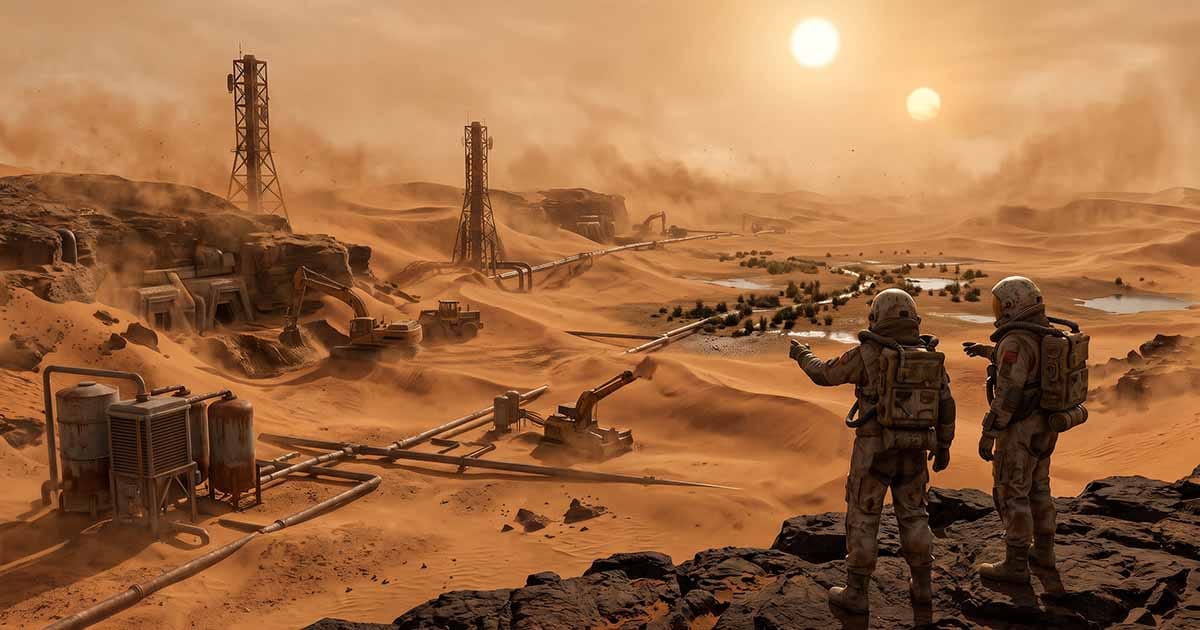
Yet humanity's ambition cannot always be contained within closed-loop suits or cavernous shelters. When survival demands conquest, sci-fi turns to macro-engineering on a titan scale: terraforming. These breathtaking concepts treat entire ecospheres as colossal thermodynamic engines waiting to be overhauled.
Pardot Kynes' Plan on Arrakis
In Dune, Imperial Planetologist Pardot Kynes envisions the grandest ecological crusade in sci-fi literature. Bypassing violent brute-force terraforming, Kynes architects an organic cascade that turns ecology into a slow-motion weapon:
- Dune-Stabilizing Grasses: Planting hardy grasses and other adapted vegetation to anchor the dunes and begin the long ecological transformation of Arrakis.
- Water Capture and Ecological Succession: Windtraps, hidden water reserves, and carefully cultivated vegetation help the Fremen accumulate the resources necessary for a transformation measured not in years, but generations.
- The Ecological Tipping Point: Altering Arrakis until the desert begins yielding to a wetter planetary environment—a breathtaking dream loaded with cosmic irony, as transforming Arrakis ultimately threatens the sandworm ecology upon which the spice itself depends.
Atmospheric Processing in Aliens
If Kynes's vision is biological poetry, Hadley's Hope on Acheron LV-426 in James Cameron's Aliens is pure industrial sledgehammer engineering, dripping with trademark Weyland-Yutani corporate charm. LV-426 is a nightmarish, frozen hellscape: a storm-lashed wasteland of jagged basalt ridges and blinding tempests—exactly the sort of grim real estate an unscrupulous board of directors loves to label an "exciting pioneer opportunity." Weyland-Yutani's towering Atmospheric Processor brute-forces this hostile frontier. These gargantuan installations labor for decades to transform LV-426's hostile atmosphere into air that human colonists can breathe. It bypasses millennial evolutionary timelines through raw industrial will, forcefully bending an alien world to human lungs—until, of course, the local fauna files a rather aggressive complaint.
Melting the Caps in the Mars Trilogy
In his seminal Mars Trilogy (beginning with Red Mars), Kim Stanley Robinson constructed the ultimate hard-SF benchmark for planetary engineering. The primordial Red Planet is an unforgiving hyper-arid desert: a razor-thin carbon dioxide atmosphere incapable of retaining much heat, savage ultraviolet radiation from above, and colossal dust storms sweeping across the volcanic peaks of Tharsis and the abyss of Valles Marineris. Robinson's pioneers launch an awe-inspiring, synchronized planetary campaign:
- Orbital Solar Mirrors: Massive orbital mirrors increase the solar energy reaching portions of the Martian surface, accelerating the warming of the frozen planet.
- Albedo Warfare via Regolith Darkening: Seeding the polar caps with black dust lowers their albedo, allowing them to absorb more solar energy and accelerating the melting of ice.
Comparative Tactics across Sci-Fi Desert Worlds
The grand dialectic of sci-fi desert survival swings between intimate, micro-scale symbiosis and roaring planetary conquest. Every civilization must balance its technological prowess against ecological humility:
| Tactical Dimension | Micro-Closed Systems | Macro-Terraforming |
|---|---|---|
| Primary Philosophy | Adapt the organism to the existing environment. | Force the environment to fit the organism. |
| Representative Works | Dune (Fremen), Mad Max: Fury Road (Wastelanders) | Mars Trilogy, Aliens (Hadley's Hope) |
| Condensation Strategy | Passive windtraps, individual wearable condensers. | Giant industrial condensation towers, nuclear snowmelt basins. |
| Energy Footprint | Extremely low; utilizes kinetic and ambient differentials. | Massively high; requires orbital mirrors and fusion grids. |
| Mobility Doctrine | Kinetic evasion, lightweight gear, irregular movement. | Heavy tracked haulers, sealed habitats, static infrastructure. |
| Ecological Impact | Negligible; leaves local biosphere undisturbed. | Complete systemic overhaul, often risking extinction of native life. |
Operational Archetypes
- Static Infrastructure vs. Kinetic Nomadism: Moisture vaporators chain communities to defensible territory, whereas nomadic sand-dwellers treat stationary structures as death traps, surviving through constant movement across the wasteland.
- Metabolic Integration vs. High-Tech Environmental Control: While industrial colonizers seal themselves inside controlled habitats, desert survivalists integrate their breath, sweat, and movement directly into the desert's flow.
The Narrative Power of Arid Worldbuilding
Why does the hyper-arid wasteland continue to exert such an intoxicating pull on the sci-fi imagination? Because the desert is the ultimate narrative crucible. If the twin suns don't roast you, the apex wildlife, a blown filtration valve, or soulless corporate bean-counters definitely will. By stripping away civilization's comforting safety nets, the author lays bare humanity's fundamental nature:
- Engineering Transmuted into Liturgy: Routine maintenance of valves, seals, and moisture traps transcends mechanics to become sacred dogma. When a cracked seal means a slow death, mechanical precision becomes the highest moral virtue.
- Unrelenting Environmental Friction: In extreme deserts, suspense does not require a monologuing villain. A jammed filtration system, a sudden silicate squall, or an empty canteen generates instant, white-knuckle dramatic tension.
- Visual and Societal Isolation: Expansive dune seas allow for profound character isolation. Communities turn inward, developing idiosyncratic dialects, insular loyalties, and profound distrust of outsiders uninitiated in the laws of moisture conservation.
- Scarcity as a Moral Litmus Test: In the radioactive salt pans and toxic dust basins of post-collapse Earth, absolute scarcity unmasks the soul: do you hoard precious groundwater beneath Immortan Joe's Citadel in Mad Max: Fury Road to rule the wretched with an iron fist, or do you forge an indomitable brotherhood where every drop is protected for the survival of tomorrow?
From Science Fiction to Applied Reality
The imaginative survival strategies forged across speculative literature are rapidly becoming real-world engineering imperatives. As Earth faces accelerating climate shifts and humanity prepares to establish permanent footholds beyond the cradle, the frontier separating fiction from reality is evaporating.
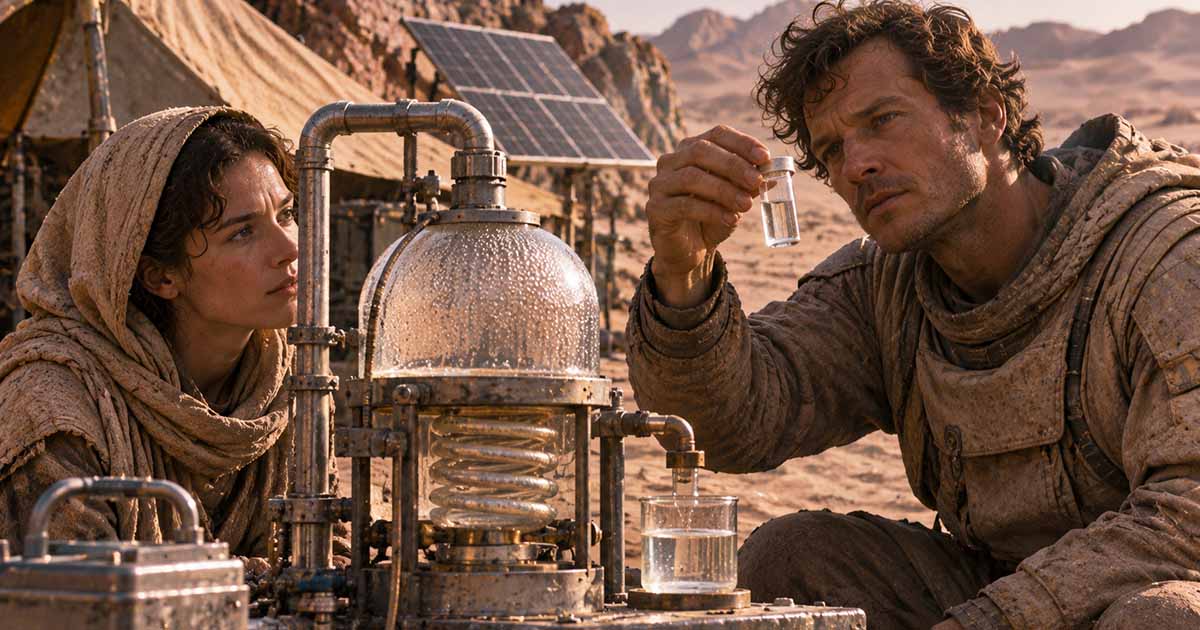
Cutting-edge atmospheric water generators using porous metal-organic frameworks (MOFs) can capture drinking water from extraordinarily dry desert air using solar energy—realizing the vision of Tatooine's vaporators. Meanwhile, the International Space Station's Environmental Control and Life Support System (ECLSS) has demonstrated 98% total water recovery, reclaiming water from sources including astronaut urine, breath, and perspiration—proving that Frank Herbert's stillsuit was not merely a fantasy, but a remarkably prescient vision of closed-loop survival technology.
Whether we are designing sustainable cities in arid river basins, building humanity's first settlements across the rust plains of Mars, or venturing into deep interstellar space, we carry the lessons of speculative fiction with us. By taming the wastelands of the imagination, science fiction provides the survival manual for our species' extraordinary future.