
The Trouble With Trust in "Who Goes There?"
In “Who Goes There?” John W. Campbell put an Antarctic crew to the test. This review examines how isolation, suspicion, and the need for proof made his 1938 novella a classic science fiction thriller.

A Familiar Face
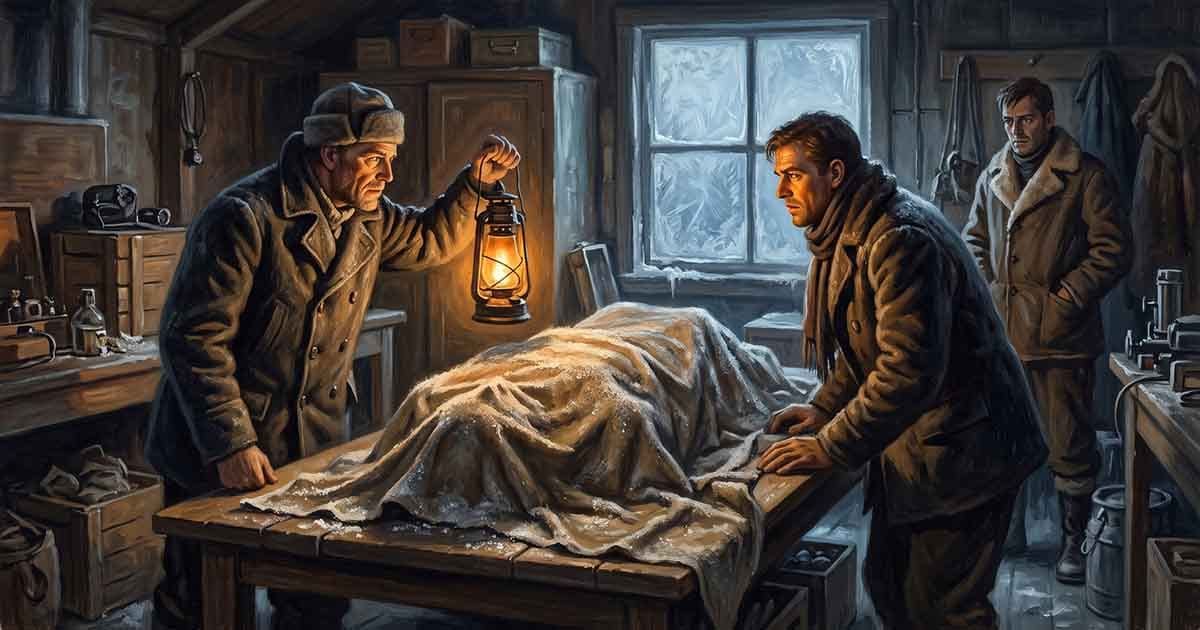
The men stood around a frozen body and argued over what to do with it. Some wanted to thaw it and find out what they had brought back to camp. Others thought they had learned enough to leave it frozen. John W. Campbell Jr. opened "Who Goes There?" with a decision any reader could understand and good reasons to take either side.
Campbell published the novella as Don A. Stuart in the August 1938 issue of "Astounding Science-Fiction." He had a knack for giving competent men a problem big enough to make their competence matter. Here he put that talent to work on a question that grew more unsettling as the story went on. How much could a man safely assume about the people he worked with every day?
"Who Goes There?" was a first-rate thriller because Campbell made the work of answering that question as gripping as the danger that raised it. A man could think straight and still start from a bad assumption. He could also be right about the danger and wrong about what to do next. Campbell gave those distinctions enough weight to carry a story whose men, for all their professional skill, sometimes sounded too much alike.
The Antarctic Camp
An expedition found a spacecraft buried in the Antarctic ice and recovered a frozen creature nearby. Campbell could have opened with the search and made a fair adventure out of the discovery alone. Instead, he began with the specimen already at camp. The men told the story of the find as they argued over whether to thaw it, so every detail about the expedition bore on a choice they had yet to make.
The ice had preserved something the men could scarcely have imagined finding. It had also put a great distance between them and anyone who might help if the examination went badly. At a laboratory back home, a scientist could consult a colleague, call for more equipment, or turn the matter over to someone with greater authority. Here the man who wanted a closer look had to make his case to the men who would share the consequences.
That gave the opening debate more substance than the usual argument between a scientist who wanted answers and a sensible man who wanted everyone home in one piece. The expedition was there to investigate what it found. A specimen from another world was about as good a reason as any to get to work. The men who urged caution had their own sound argument. Nobody in the room knew what counted as a reasonable precaution around a creature whose biology was entirely unfamiliar.
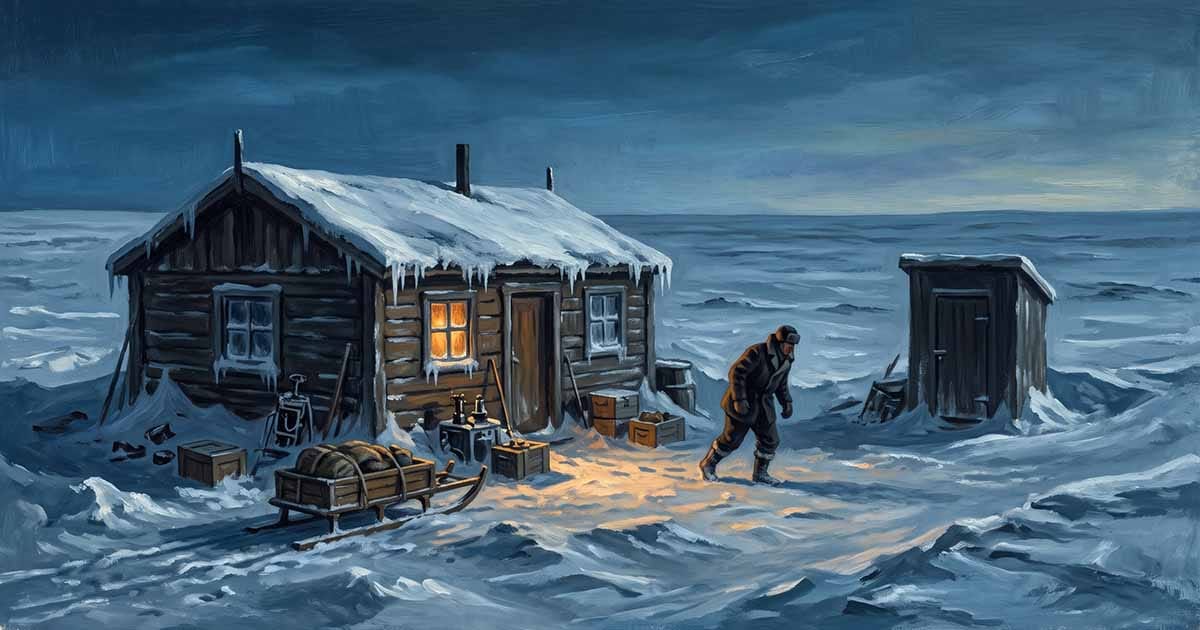
The camp itself made that uncertainty worse. It was a place where men had brought order to an inhospitable stretch of country with tools, routines, and a division of labor. The frozen body lay within that small, familiar world. For all the experience in the room, nobody could say with confidence what would happen if it warmed up.
Suspicion and Proof
The question changed as the story went on. At first the men had to judge a thing they could all see. Later, the harder work was deciding how much confidence to put in what seemed plain. Campbell understood how quickly a room full of capable men could reach different conclusions from the same facts, especially when one man heard a warning where another heard a guess.
He also knew that a man could make a perfectly sensible observation and draw more from it than it warranted. A colleague's hesitation might be worth noticing. It might also mean that a tired man wanted a moment to think before saying something he would have to defend. Under ordinary circumstances the difference would scarcely matter. At the camp, a bad reading of another man's conduct could influence what everyone did next.
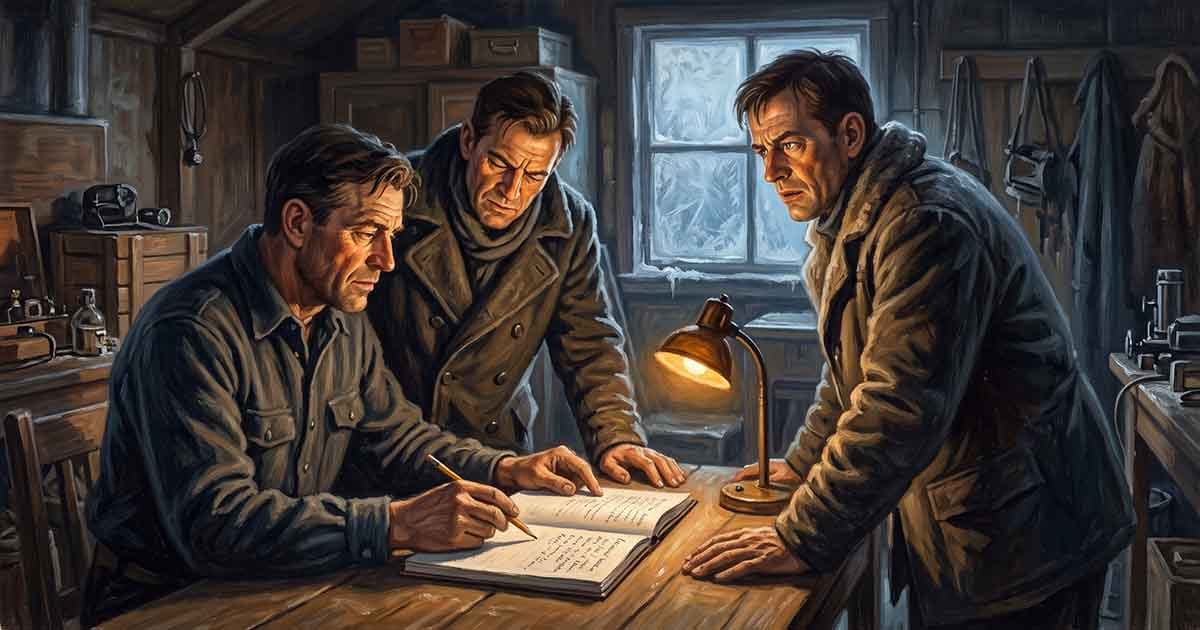
The novella was at its best when somebody had to turn a suspicion into a question the others could examine. Campbell gave those discussions time to develop. One man proposed an explanation, another found the weakness in it, and the first had to decide whether his idea could survive the objection. The reader got to follow the argument closely enough to have an opinion before the men had settled theirs.
That was where the science fiction and the horror belonged together. Campbell gave the men a phenomenon outside their experience, then asked what they could learn about it with the means at hand. Every plausible explanation carried a practical consequence. The crew could afford a mistake in theory only so long as nobody acted on it.
The men also had to ask what they owed one another while doubt remained. A man who dismissed a warning because he disliked the fellow who gave it could endanger the whole camp. A man who treated his own fear as sufficient proof could do the same. Both still had a duty to listen, and neither could discharge it simply by being certain he was right.
Campbell occasionally made a man sound as though he were delivering a technical briefing. Yet the space he gave to deliberation paid off. Anyone could imagine being frightened in that camp. The more demanding exercise was imagining what would persuade you to act, how you would explain your grounds to the men beside you, and whether you would hear them out if they thought you had it wrong.
Men Under Pressure
McReady gave those arguments a center. The expedition's meteorologist had the practical habit of asking what an explanation would account for and what it would leave open. A confident opinion might get his attention, but it still had to answer a question or fit an observation. In a camp full of specialists, that was a useful way to listen.
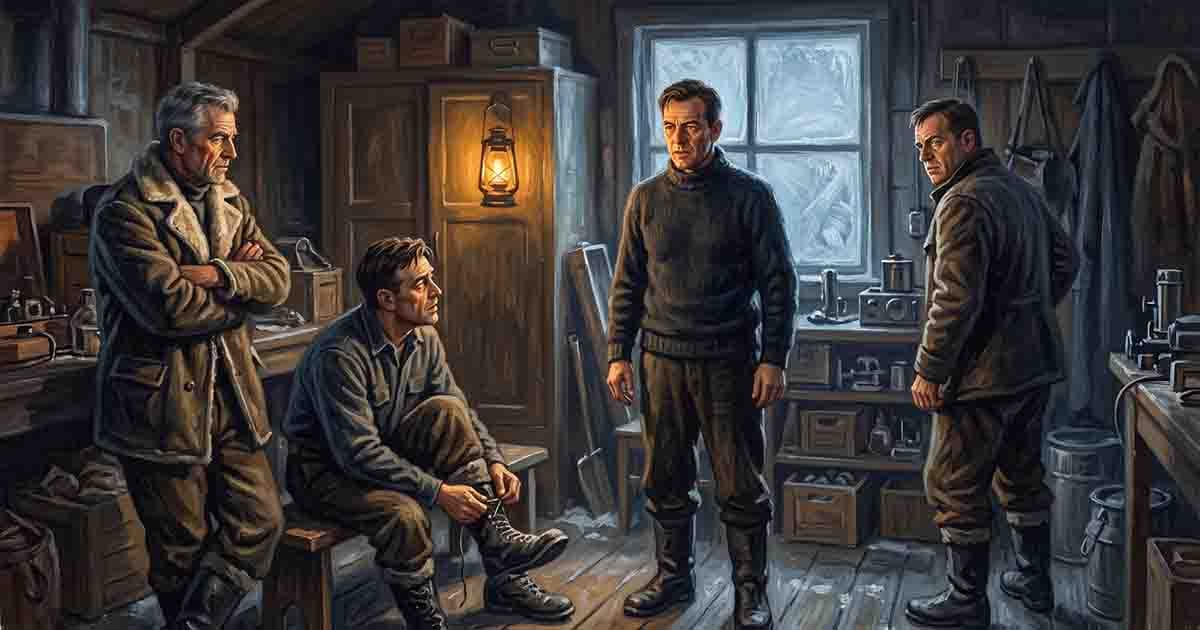
Campbell was good at giving men the authority that came from knowing their work. Blair approached the frozen creature as a biologist. Norris, the physicist, had misgivings about the thaw, and Commander Garry had to weigh what the men told him against his responsibility for the camp. Their different positions gave the opening discussion a shape. It mattered who spoke because each man had a different reason to care about the answer.
Their voices were harder to tell apart. Once several men began arguing in earnest, Campbell often gave them the same clipped, emphatic manner. A name and a job could tell the reader who had spoken, while the words themselves offered fewer clues. A little more of the easy banter or private irritation that develops among men who work together would have made the crew feel more like a company that had already spent months in close quarters.
Campbell also shifted his attention among the men. At its best, that let the reader see how a worry voiced by one man took on a different meaning when another heard it. At other times, the movement made it harder to follow any one man's train of thought. The story gained a wider view of the camp and sometimes lost the intimacy that would have made the danger feel personal.
That weakness mattered particularly here. A reader who knew how a man joked, what he took offense at, or how he behaved when he was tired would bring that knowledge to every conversation. Campbell gave his crew enough character to make their decisions intelligible. A few more particulars would have made their company harder to leave.

Campbell on the Page
Readers who came to "Who Goes There?" through John Carpenter's "The Thing" (1982) had an especially good reason to spend time with the novella. On the page, an objection could have the floor for a full exchange. A reader could stop over a line, consider whether it answered the previous one, and discover that a man who sounded entirely reasonable had left something important unexplained.
That pleasure made the novella an easy recommendation for readers who liked a mystery with a real problem to solve. Some of the dialogue was stiff, and several of the men were easier to remember by occupation than by name. The arguments held up better. Campbell took the crew's work seriously enough to let a disagreement develop before the story demanded a decision.
The opening scene contained much of what made the novella worth reading. A man could stand over that frozen body and see the discovery of a lifetime. His companion could look at the same thing and see a decision the whole crew would have to live with. Campbell put both men in the room, gave each a fair hearing, and left the reader with a question that outlasted the immediate fright. How sure would you have wanted to be before asking the men beside you to take the risk?