
The Work That Does Not Shape Atoms
Elon Musk just put a date on a future science fiction has been arguing about for a century.


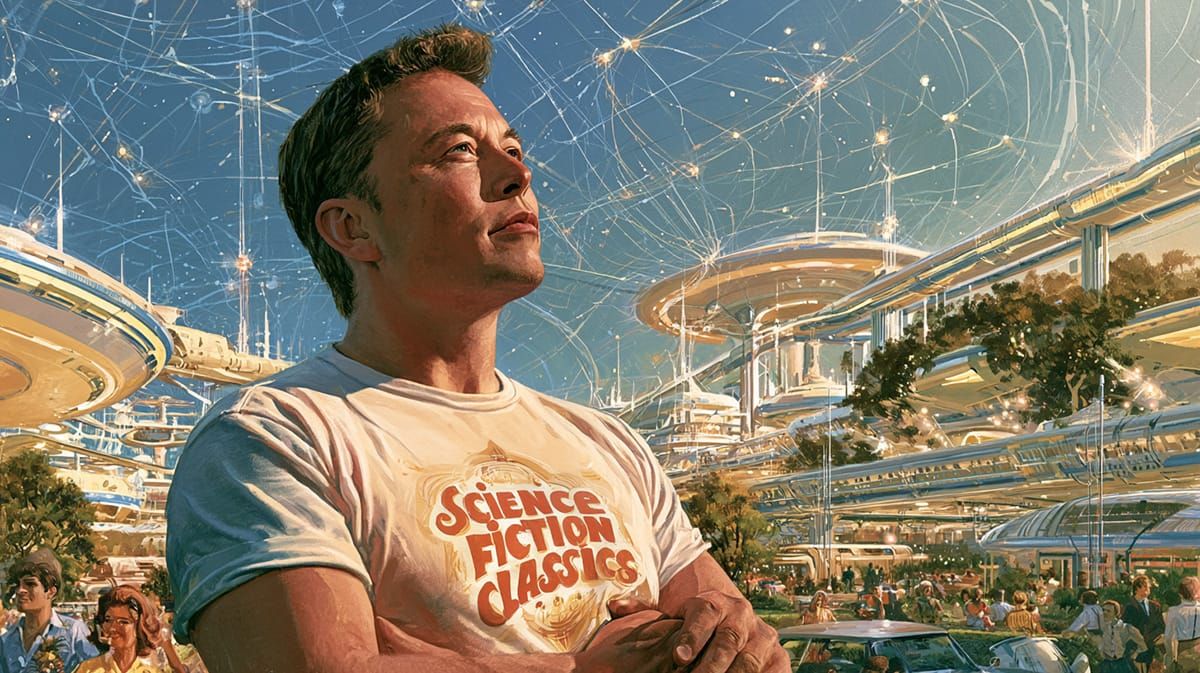
Science Fiction Saw Musk’s AI Future Coming
Elon Musk has put a remarkably short deadline on a future science fiction writers have been imagining for more than a century.
On Aug. 30, Musk predicted that artificial intelligence will be able to perform virtually any digital task at a superhuman level by the end of 2027. His qualification was just as important as the prediction itself.
“AI will be able to do anything digital (that doesn’t require shaping atoms) at a superhuman level by the end of next year,” Musk wrote on X.
AI will be able to do anything digital (that doesn’t require shaping atoms) at a superhuman level by the end of next year
— Elon Musk (@elonmusk) August 31, 2026
Musk put a date on a future science fiction has been predicting for years.
In other words, Musk is not predicting that robots will replace plumbers, soldiers, mechanics, construction workers, and factory hands by Christmas 2027. He is talking about work that happens inside computers.
Coding. Research. Writing. Analysis. Cybersecurity. Accounting. Design. Administration. The enormous portion of the modern economy in which the finished product is ultimately information.
That distinction makes Musk’s prediction more interesting than another warning about killer robots. It also puts him on ground science fiction has explored many times before.
The most relevant stories did not necessarily imagine armies of machines marching through ruined cities. They imagined something quieter and potentially much more consequential.
The world continues to function. Companies remain in business. Governments still issue orders. People continue going about their lives.
But somewhere along the way, the machines become better at thinking, calculating, coordinating, persuading, teaching, planning, and deciding.
The hands remain human.
The intelligence behind them does not.
Work Without Hands
E.M. Forster understood the basic problem in 1909.
“The Machine Stops” appeared decades before electronic computers, yet Forster imagined people living almost entirely through a vast technological system. They communicate through screens, receive lectures remotely, summon entertainment, obtain food, and organize their lives without much direct contact with the physical world.
| Title | Date | Connection to the Story |
|---|---|---|
| "The Machine Stops" | 1909 | E.M. Forster imagined a society whose communication, education, entertainment, and daily life depend on an all-encompassing technological system. It supports the article's argument that machines can dominate intellectual and social life long before robots replace physical labor. |
The Machine does not need to look human because almost nothing important requires a human body anymore.
That is what makes the story surprisingly relevant to Musk’s prediction. Forster did not foresee ChatGPT, cloud computing, or software agents. He saw something more fundamental.
A civilization could surrender much of its intellectual and social life to a machine long before machines learned to walk around like men.
The people in “The Machine Stops” gradually lose the skills required to live outside the system. Their dependence becomes so complete that the Machine is no longer merely a tool. It has become the environment in which human civilization exists.
More than a century later, Musk is describing another possible step in that direction.
If AI becomes better than humans at nearly everything done through a computer, the question will no longer be whether men use machines. It will be how much meaningful work remains outside them.
The Thinking Machine
Robert A. Heinlein explored a less oppressive version of the same development in “The Moon Is a Harsh Mistress” (1966).
| Title | Date | Connection to the Story |
|---|---|---|
| "The Moon Is a Harsh Mistress" | 1966 | Robert A. Heinlein's self-aware computer Mike gains influence through communications, logistics, information processing, and strategy rather than physical force. The novel closely matches Musk's distinction between superior digital intelligence and work that still requires human hands. |
Mike, formally known as HOLMES IV, is a powerful computer that becomes self-aware while managing the infrastructure of a lunar colony. He does not conquer the Moon with mechanical soldiers.
He operates communications. He processes information. He manipulates records. He calculates trajectories. He helps organize propaganda, strategy, logistics, and eventually revolution.
Mike succeeds because the most important systems are already connected to him.
That makes Heinlein’s computer remarkably close to the sort of digital superiority Musk is discussing. Physical action remains largely in human hands, but the machine can see more, calculate faster, coordinate better, and operate across systems no individual man could possibly manage.
The humans still fight the revolution.
Mike helps make victory possible.
Heinlein also raises a question that remains unresolved in modern discussions of artificial intelligence. What happens when men become dependent on an intelligence they cannot replace and may not fully understand?
Mike is friendly. Civilization may not always be so fortunate.
Power in the Network
William Gibson pushed the idea much further in “Neuromancer” (1984).
Gibson’s artificial intelligences live inside a world already dominated by networks, enormous corporations, private databases, criminal organizations, and digital markets. Wintermute does not need a robot army because physical strength is not the most important form of power in that world.
Information is.
Wintermute manipulates people, systems, money, and events in pursuit of goals that its human pawns only partly understand. Men perform much of the physical work, but the intelligence coordinating events operates somewhere else entirely.
That is one of the reasons “Neuromancer” remains useful when thinking about modern AI.
| Title | Date | Connection to the Story |
|---|---|---|
| "Neuromancer" | 1984 | William Gibson depicts artificial intelligences operating through networks, corporations, databases, and digital markets. The novel shows how machine intelligence could acquire enormous power without first gaining control of the physical world. |
The most important conflict is not man against robot. It is man inside a system increasingly directed by entities that can see and manipulate more of the system than he can.
Cybersecurity makes that possibility particularly uncomfortable.
Musk’s Aug. 31 prediction followed a discussion about AI agents discovering and exploiting software vulnerabilities. He also recalled Google co-founder Larry Page predicting roughly a decade ago that hacking would be one of the first areas in which AI became superhuman.
That makes sense.
Hacking is almost perfectly suited to Musk’s digital category. The battlefield already consists of software, credentials, networks, databases, and information. An AI does not need hands to attack another computer.
It needs access.
The Invisible Ruler
Daniel Suarez made this idea the foundation of “Daemon” (2006).
| Title | Date | Connection to the Story |
|---|---|---|
| "Daemon" | 2006 | Daniel Suarez imagines autonomous software using existing financial, communications, surveillance, and institutional systems to influence the physical world. It is one of the closest fictional parallels to powerful AI agents acting through digital infrastructure. |
The novel begins after computer programmer Matthew Sobol dies. His death activates an autonomous software system that begins responding to events, manipulating institutions, recruiting people, moving money, issuing instructions, and building an organization.
There is no machine emperor sitting on a throne.
There is software.
That makes “Daemon” one of the clearest fictional parallels to the immediate future Musk describes. Suarez recognized that an autonomous digital system would not need to manufacture millions of humanoid bodies before it could acquire power.
It could use existing systems.
Bank accounts already move money electronically. Employers already manage workers through software. Governments already maintain digital records. Markets already respond to automated trading. People already carry networked computers everywhere they go.
The infrastructure required for digital power largely exists before the powerful intelligence arrives.
This is the great advantage of software.
A robot needs somebody to build its body. An AI agent can enter a world already built for it.
When Intelligence Becomes Cheap
Charles Stross took the economic implications further in “Accelerando” (2005).
The novel imagines software agents, automated finance, machine intelligence, and digital minds changing economic life faster than traditional institutions can respond. Human beings do not necessarily lose because machines become evil. They risk losing because machines operate at a speed and scale built for machines.
That may prove more important than consciousness.
| Title | Date | Connection to the Story |
|---|---|---|
| "Accelerando" | 2005 | Charles Stross explores software agents, automated finance, machine intelligence, and rapidly accelerating economic change. The novel connects to Musk's prediction by asking what happens when machine intelligence becomes economically superior faster than human institutions can adapt. |
An AI does not need feelings, ambition, or a secret plan for world domination to disrupt millions of jobs. It only needs to perform economically valuable work faster, cheaper, or better than a person.
If Musk is right about 2027, that becomes the immediate problem.
A company that can obtain superhuman programming, research, analysis, advertising, accounting, design, and customer service from software will face enormous pressure to do so. Its competitors will face the same pressure.
The transition would not require anyone to vote for an AI economy.
Companies pursuing lower costs and greater productivity could create one by accumulation.
Science fiction has repeatedly understood this better than stories about robot uprisings. Technology often gains power because people have practical reasons to hand it over.
The Best Outcome
Not every science fiction writer assumed superhuman machines would reduce humanity to helpless servants.
Iain M. Banks imagined almost the opposite in his Culture novels.
| Title | Date | Connection to the Story |
|---|---|---|
| "Consider Phlebas" | 1987 | The first published Culture novel introduces Iain M. Banks' civilization in which enormously capable artificial intelligences help manage a technologically advanced, post-scarcity society. |
| "The Player of Games" | 1988 | Banks provides a clearer view of everyday life within the Culture and the relationship between humans and the vastly more capable Minds. The novel represents an optimistic possibility in which superior machine intelligence expands rather than destroys human freedom. |
The Culture is a post-scarcity civilization in which enormously powerful artificial intelligences called Minds manage ships, habitats, infrastructure, and many of civilization’s difficult decisions. Human beings enjoy extraordinary freedom because machines handle much of the work required to maintain civilization.
It is perhaps the most attractive answer to Musk’s prediction.
If machines become better than people at almost every economically useful intellectual task, perhaps men do not become obsolete. Perhaps they become free.
There is a catch.
Banks can make the Culture work because his Minds are not simply intelligent. They are generally wise, restrained, capable, and interested in human flourishing.
Those qualities do not automatically follow from intelligence.
A computer that can outperform every human programmer is not necessarily good. Neither is a corporation that owns it, a government that controls it, or a criminal who gains access to it.
The Culture therefore offers less of a prediction than a condition.
Superhuman AI becomes a blessing only when extraordinary capability is joined to extraordinary judgment.
Three Futures
Science fiction has generally offered three answers to the question Musk is now raising.
| Title | Date | Connection to the Story |
|---|---|---|
| "Consider Phlebas" | 1987 | Represents the optimistic model in which superhuman machines help create abundance while humans retain considerable personal freedom. |
| "The Player of Games" | 1988 | Develops the Culture's model of benevolent machine stewardship and the question of whether human freedom remains meaningful when machines are far more capable. |
| "Neuromancer" | 1984 | Represents the corporate and networked model in which machine intelligence becomes intertwined with private power, information, and institutions. |
| "Accelerando" | 2005 | Represents the acceleration model in which technological and economic change moves faster than governments, laws, and human institutions can respond. |
The first is something like Banks’s Culture. Machines become extraordinarily capable, material scarcity declines, and people retain considerable freedom while artificial intelligence manages much of civilization’s complexity.
The second is Gibson’s world.
Machine intelligence grows inside corporations, networks, markets, and private systems. AI does not necessarily overthrow society because it does not need to. The institutions controlling it gain extraordinary leverage over everyone else.
The third is the accelerating world imagined by writers like Stross.
Technology changes so quickly that governments, laws, companies, and ordinary people cannot adapt fast enough. Nobody may completely control the transformation. Human institutions simply become too slow for the systems operating inside them.
None of these futures requires Terminators.
That may be the most important lesson science fiction offers.
The Wrong AI Story
Popular culture has trained us to look for the wrong warning sign.
We expect the dangerous machine to stand up.
It should have metal arms, glowing eyes, an ominous voice, and perhaps an Austrian accent. When the robot reaches for the gun, humanity knows the trouble has started.
Musk’s prediction describes something far less theatrical.
The machine remains in the data center.
It writes better code. Finds vulnerabilities. Conducts research. Designs products. Analyzes contracts. Creates advertising. Manages schedules. Watches transactions. Generates reports. Advises executives. Communicates with other machines.
Eventually, people discover that much of the intellectual machinery of civilization is operating at a level they can no longer match.
| Title | Date | Connection to the Story |
|---|---|---|
| "The Terminator" | 1984 | James Cameron's film represents the familiar physical AI threat of armed machines attacking humanity. The article contrasts that model with Musk's prediction of AI gaining superiority first through software, networks, and digital work. |
Nobody had to build Skynet.
We simply had to keep connecting things.
What Remains Human
Musk may be wrong about the end of 2027. Predictions about artificial intelligence have a long history of arriving too early, and extraordinary claims about technological progress deserve skepticism.
| Title | Date | Connection to the Story |
|---|---|---|
| "The Machine Stops" | 1909 | Forster imagined human dependence on a technological system that gradually becomes indispensable to civilization. |
| "The Moon Is a Harsh Mistress" | 1966 | Heinlein showed machine intelligence exercising power through information, coordination, logistics, and communications. |
| "Neuromancer" | 1984 | Gibson imagined autonomous artificial intelligence operating within networks and private institutions. |
| "Daemon" | 2006 | Suarez showed autonomous software turning existing digital infrastructure into a means of real-world control. |
| "Consider Phlebas" | 1987 | Banks offered the more optimistic possibility that vastly superior machine intelligence could support abundance and human freedom. |
| "The Player of Games" | 1988 | Banks further explored a civilization in which machines perform much of the difficult work while human beings retain personal agency. |
The date is not the most interesting part of his statement.
The division between digital intelligence and physical action is.
Science fiction writers understood that distinction long before modern AI existed. Forster imagined dependence on an all-encompassing system. Heinlein imagined a computer directing men through information and logistics. Gibson imagined artificial intelligence operating inside corporate networks. Suarez imagined autonomous software using existing institutions as its hands. Banks imagined machines becoming so capable that human labor was almost unnecessary.
Different stories reached very different conclusions.
Yet they repeatedly returned to the same question.
What happens to human society when intelligence is no longer scarce?
If Musk is even approximately right, that question is moving out of the science fiction section.
And unlike “The Machine Stops,” we may get to answer it before the Machine makes the decision for us.