
What Is the Golden Path in "Dune"
What is the Golden Path in "Dune"? Learn how it differs from Paul's jihad, why Leto II embraced it, and why Frank Herbert saw it as humanity's only path to survival.


"Golden Path"
Few ideas in science fiction are as ambitious as the Golden Path. Introduced gradually across Frank Herbert's "Dune" series, it begins as a troubling vision seen by Paul Atreides and eventually becomes the defining purpose of his son, Leto II. The Golden Path is not a prophecy waiting to be fulfilled. It is a deliberate plan to ensure that humanity survives far into the future, even if achieving that goal demands extraordinary sacrifice.
The concept is often misunderstood because it unfolds over several novels rather than a single story. Many readers assume the Golden Path is simply another name for Paul's jihad or that it represents Leto II's dictatorship. Neither explanation is complete. The jihad is one consequence of Paul's rise to power. Leto's empire is one tool used to achieve the Golden Path. The Golden Path itself is a far larger vision, one that seeks to make humanity too widespread, too independent, and too unpredictable to ever be destroyed by a single catastrophe or controlled by a single ruler.
| FIELD | DETAILS |
|---|---|
| Name | Golden Path |
| Aliases | Leto II's Golden Path, The Narrow Path |
| Affiliation | Paul Atreides, Leto II Atreides, House Atreides |
| First Appearance | "Children of Dune" by Frank Herbert, 1976 |
| Film Appearance | Foreshadowed in "Dune" (1984), "Dune" (2021), and "Dune Part Two" (2024) |
| Miniseries Appearance | Explored in "Frank Herbert's Children of Dune" (2003) |
| Role | Humanity's long-term survival plan against extinction, stagnation, and prescient control |
| Description | A future path seen by Paul and fulfilled by Leto II to make humanity too scattered and unpredictable to be ruled or destroyed by one power. |
| Key Figures | Paul Atreides, Leto II, Siona Atreides |
| Major Themes | Prophecy, tyranny, survival, free will, human evolution |
| Created By | Frank Herbert |
Origins And Context
Frank Herbert first hints at the Golden Path in "Dune" (1965), although the name and its full meaning do not emerge until later books. As Paul Atreides awakens to prescience through the spice melange, he begins to see countless possible futures. Most of those futures end badly. Some lead to endless war. Others lead to stagnation, where humanity becomes trapped in patterns that eventually guarantee its destruction.
This reflects one of Herbert's central ideas about power. He believed that civilizations become fragile when they place too much trust in one leader, one institution, or one way of thinking. Prescience, which appears to be a gift, becomes part of the problem. If one person can always see the future, everyone else gradually loses the freedom to shape it.

The danger is not simply political. It is evolutionary. Humanity becomes increasingly predictable, and anything that becomes predictable can eventually be controlled or destroyed. Herbert imagined a future where comfort and stability slowly weaken civilization until it can no longer adapt to unexpected threats.
Seen in that light, the Golden Path is less about saving an empire than saving a species. The Atreides family becomes the instrument of that plan, but Herbert never suggests that their dynasty is the ultimate goal. Humanity itself is the prize.
Role In The Story
During the events of "Dune," Paul struggles against the future he sees unfolding around him. His greatest fear is the religious crusade carried out in his name after he becomes Muad'Dib. Although he wins the Imperial throne, he realizes that victory comes at an enormous human cost. Billions die in wars fought by followers who believe they are carrying out a sacred mission.

That holy war is often confused with the Golden Path, but the two are fundamentally different. The jihad is an immediate political and religious consequence of Paul's rise. The Golden Path is a much longer plan that extends thousands of years beyond Paul's lifetime. One is a tragedy that cannot be fully prevented. The other is an attempt to prevent humanity's eventual extinction.
As Paul's prescience grows stronger, he sees that the greatest threat is not the jihad itself. Instead, it is humanity's increasing dependence on centralized authority, prophetic leadership, and the illusion that one extraordinary person can safely guide civilization forever. If that pattern continues, mankind will eventually become too rigid to survive.
Paul recognizes the solution, but he cannot bring himself to carry it out. He understands that someone would have to surrender his own humanity, rule as an absolute tyrant for millennia, and deliberately shape civilization through oppression rather than inspiration. It is a burden Paul refuses to accept.
How Paul's Jihad Differs
Understanding the difference between Paul's jihad and the Golden Path helps explain the direction of the later novels.
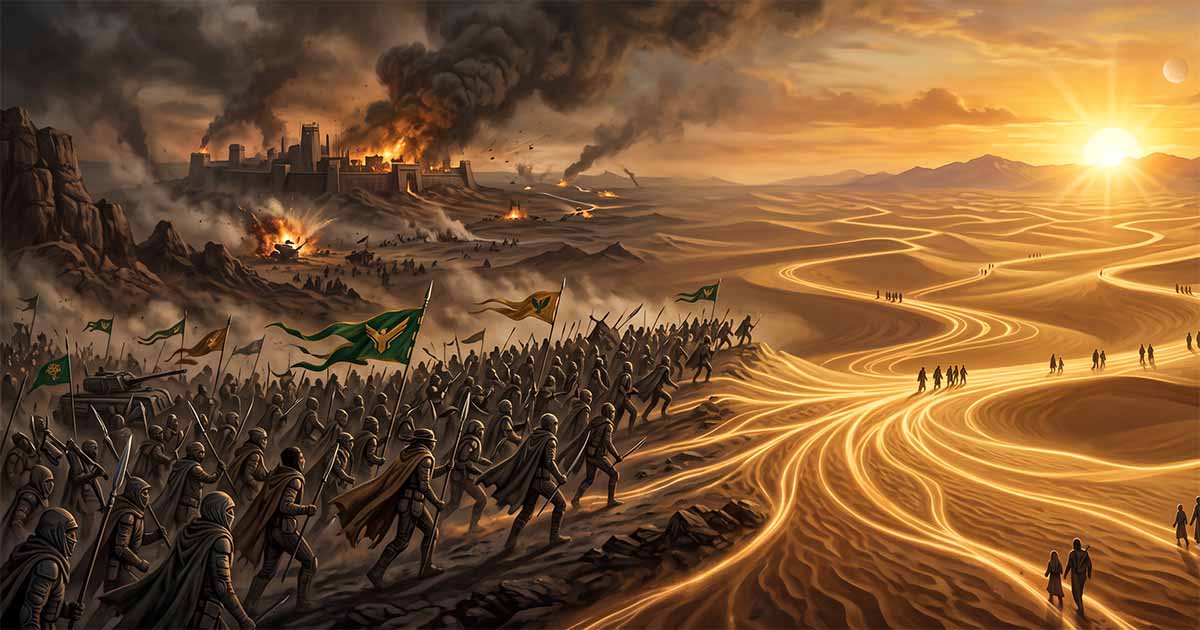
Paul's jihad is an explosion. It reshapes the Imperium through conquest, religious zeal, and political revolution. It happens because millions believe Paul is their destined leader.
The Golden Path is a long strategy. It seeks to reshape humanity itself by ensuring that no future empire, religion, or prescient ruler can ever dominate the species again. Rather than creating dependence on a messiah, it is designed to make future messiahs impossible.
The two ideas are connected, but they serve different purposes. Herbert uses the jihad to show the dangers of charismatic leadership. He uses the Golden Path to explore whether humanity can escape that cycle once it has begun.
Why Leto Accepted
Spoiler warning for later novels.
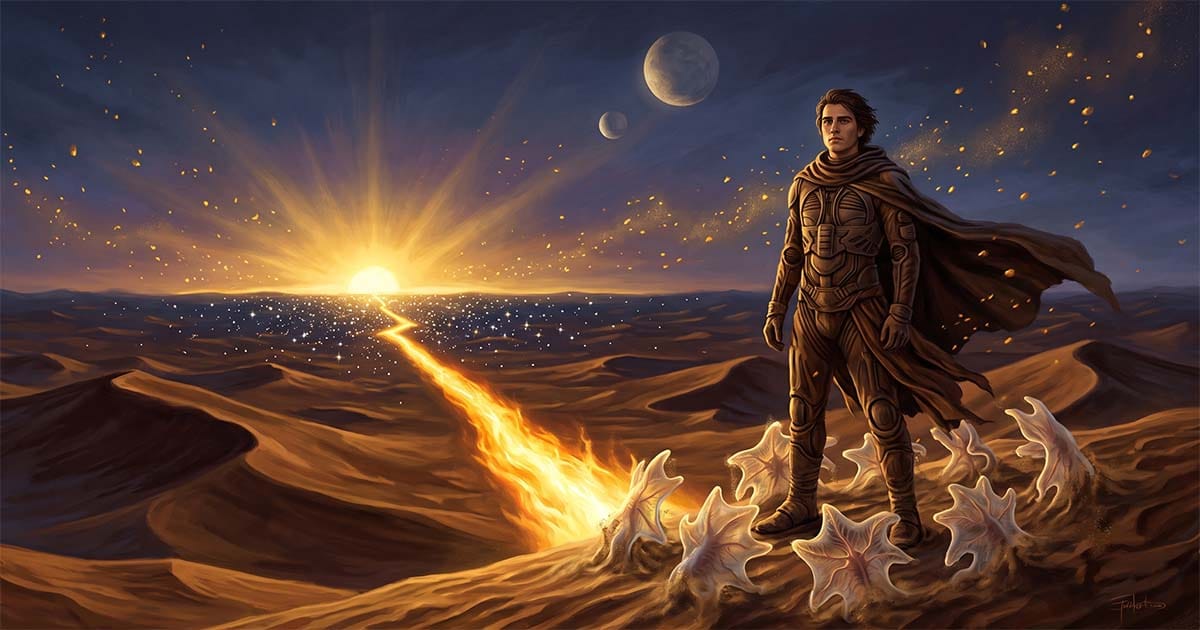
Leto II reaches a conclusion that his father cannot accept. He believes the survival of humanity outweighs every personal sacrifice, including his own. In "Children of Dune," he begins merging with sandtrout, setting himself on the path to becoming the God Emperor. By "God Emperor of Dune," he has ruled for more than three thousand years.
Leto's reign is intentionally harsh. He limits expansion, suppresses rebellion, and keeps humanity under strict control. These policies are never presented as desirable. Instead, Herbert portrays them as temporary medicine for a civilization that has become dangerously dependent on stability and centralized power.
Leto's true goal is freedom, but not during his own lifetime. He wants future generations to reject absolute rulers forever. When his reign finally ends, humanity spreads across the universe in the Scattering, creating countless independent civilizations beyond the reach of any single empire.
Leto also guides the Atreides bloodline toward descendants like Siona, whose unique genetics make them invisible to prescient vision. Combined with the Scattering, this makes humanity both geographically dispersed and impossible to control through prophecy.
The Golden Path ends where it began, with survival. Herbert leaves readers to wrestle with its central question. Can tyranny ever be justified if it prevents extinction? He offers no simple answer. Instead, he invites each generation of readers to decide whether Leto II became humanity's greatest protector, its greatest monster, or both.