
Why Edric Matters in Dune
Edric, the Spacing Guild Navigator from "Dune Messiah," reveals the limits of prescience, the Guild’s dependence on spice, and the risks facing Paul Atreides.


Edric The Navigator Who Could Hide From Paul Atreides
Edric is one of the strangest characters in Frank Herbert's "Dune" universe, even by the standards of a saga populated by Mentats, Bene Gesserit, Face Dancers, and sandworms. Introduced in "Dune Messiah" (1969), he is a Spacing Guild Navigator whose body and mind have been transformed by enormous exposure to melange.
He is also far more important than his page count suggests. Edric helps answer one of the most troublesome questions created by the first "Dune" novel. How can anyone successfully plot against Paul Atreides when Paul can see possible futures?
The answer reveals something important about Herbert's conception of prescience. Seeing the future does not necessarily mean seeing everything.

Origins and Context
Edric does not appear in "Dune" (1965), although the Spacing Guild is already one of the great powers of the Imperium. The Guild controls interstellar transportation because its Navigators use spice-enhanced prescience to find safe paths through space.
That ability comes with a severe price. Navigators consume extraordinary amounts of melange, and Edric has become so physically transformed that Herbert describes him in distinctly fishlike terms.
Edric therefore represents both the strength and weakness of the Guild. Its Navigators possess an ability upon which civilization depends, but they cannot maintain that ability without the spice found on Arrakis.
Paul's victory in "Dune" radically changes this balance. Once he controls Arrakis and threatens spice production, even the mighty Spacing Guild must take him seriously.
That dependency gives "Dune Messiah" much of its political tension. Edric represents an organization that needs Paul's empire while also having powerful reasons to fear it.
| Name | Edric |
|---|---|
| Affiliation | Spacing Guild |
| First Appearance | "Dune Messiah" (1969) by Frank Herbert |
| Role | Guild Navigator and representative in the conspiracy against Paul Atreides |
| Description | Spice-transformed, prescient Navigator whose abilities interfere with Paul’s foresight |
| Portrayed by | Terrence Stone (2003) |
Role in the Story
SPOILER WARNING FOR "DUNE MESSIAH"
Edric enters the novel as part of a conspiracy involving the Tleilaxu Face Dancer Scytale, Bene Gesserit Reverend Mother Gaius Helen Mohiam, and Princess Irulan. Each represents interests threatened or frustrated by Paul's rule, but Edric brings something none of the others can provide.
He brings another oracle.
Paul's prescience makes an ordinary conspiracy exceptionally difficult. Plans against him can become part of the futures he observes before the conspirators ever act.
Edric changes that equation because he is prescient himself. Herbert establishes that the interaction between prescient observers can obscure their actions from one another, creating uncertainty where Paul would otherwise possess extraordinary foresight.
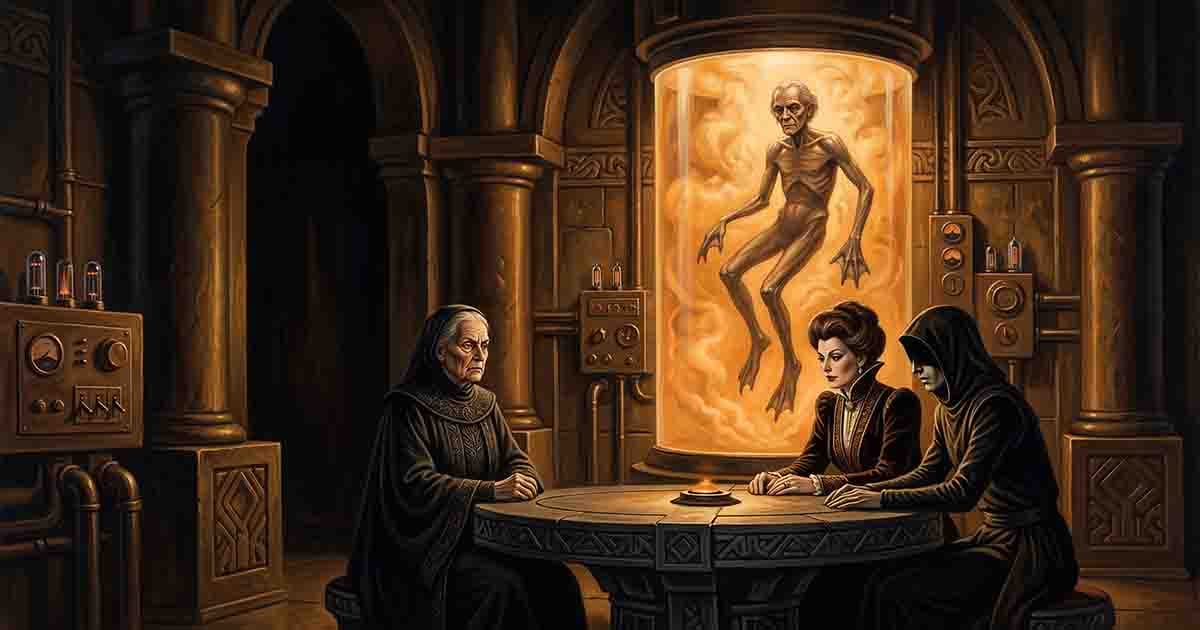
That makes Edric something more interesting than the conspiracy's Guild representative. His presence gives the plotters a kind of prescient shelter in which their plans can develop beyond Paul's normal vision.
Edric is not portrayed as Paul's equal. His prescience is specialized around the needs of Guild navigation, while Paul perceives vast networks of possible futures and the consequences flowing from human decisions.
Edric nevertheless possesses exactly the ability the conspiracy requires. He does not need to defeat Paul's prescience. He only needs to interfere with it.
The conspiracy ultimately fails to achieve its larger purpose. Edric pays for his involvement when Alia orders Stilgar to execute him along with Mohiam.

Power and Prescience
Edric helps Herbert clarify that prescience in "Dune" is not omniscience. Paul can perceive possible futures with astonishing accuracy, but his vision has limits, uncertainties, and areas that other prescient forces can obscure.
This distinction matters because "Dune Messiah" deliberately overturns some of the apparent triumphs of "Dune." Paul has gained an empire and immense prophetic power, yet those achievements increasingly restrict rather than liberate him.
Edric embodies the same paradox on a smaller scale. Spice has given him abilities beyond ordinary humanity, but those abilities have also transformed his body and made his existence dependent upon melange.
The Spacing Guild suffers from the same problem. It dominates interstellar travel, yet its monopoly rests on a substance produced in one extraordinarily vulnerable place.
Edric therefore illustrates one of Herbert's recurring ideas about specialization. A civilization can become remarkably powerful by perfecting one ability while simultaneously making itself dangerously dependent upon the conditions that sustain that ability.

Why Edric Matters
Edric matters because he exposes the limits of seemingly absolute power. Paul cannot see everything, the Guild cannot operate without spice, and even a Navigator capable of perceiving the future cannot guarantee the future he wants.
He also connects several of Herbert's largest ideas in one relatively minor character. Ecology produces spice, spice produces prescience, prescience enables Guild power, and dependence on spice allows control of Arrakis to become control over civilization.
Screen adaptations can make Edric slightly confusing. David Lynch's "Dune" (1984) features an unnamed Third Stage Guild Navigator, but that character is not Edric.
The 2003 miniseries "Frank Herbert’s Children of Dune" directly adapts Edric, with Terrence Stone playing the Navigator. The forthcoming "Dune: Part Three" is based on "Dune Messiah," and current promotional material has brought Guild Navigators prominently into Villeneuve's screen universe.
Edric ultimately works because Herbert does not need him to dominate the novel. He needs Edric to demonstrate a more unsettling proposition. The man who sees the future can still have a blind spot.