
House Atreides From Caladan to Empire
House Atreides begins as one of the Imperium’s most respected noble families. Learn its origins, fall on Arrakis, rise through Paul, and lasting legacy across the "Dune" novels and major adaptations.


Who Is House Atreides
House Atreides is the noble family at the heart of Frank Herbert's "Dune." Led by Duke Leto Atreides at the beginning of the novel, the house governs the ocean world Caladan before receiving an imperial order to take control of Arrakis.
The Atreides are not the wealthiest or most militarily dominant power in the Imperium. Their strength comes from Duke Leto's reputation, capable soldiers, exceptional retainers, and an unusual ability to inspire personal loyalty.
That reputation also makes them dangerous. The destruction of Duke Leto's government on Arrakis does not eliminate House Atreides, but instead begins its transformation into one of the most consequential dynasties in Herbert's future history.
| Name | House Atreides |
|---|---|
| Affiliation | Landsraad, Imperium, later allied with the Fremen |
| First Appearance | "Dune" (1965) by Frank Herbert |
| Role | Great House of the Imperium and ruling family of Caladan before taking Arrakis |
| Description | Respected noble house known for capable leadership, loyal retainers, and skilled military forces |
| Notable Members | Duke Leto Atreides, Paul Atreides, Alia Atreides, Leto II, Ghanima Atreides |
| Homeworld | Caladan, followed by Arrakis as its assigned fief |
Origins and Context
House Atreides is one of the Great Houses operating beneath Padishah Emperor Shaddam IV. These families govern planetary fiefs, participate in the Landsraad, and compete for political and economic influence across the Imperium.
Before "Dune," the Atreides rule Caladan, a world of oceans, rain, and abundant water. Duke Leto governs with Lady Jessica, his Bene Gesserit partner, while their 15-year-old son Paul is raised as the heir to the house.
The Emperor orders the Atreides to leave Caladan and assume control of Arrakis, the only known source of the spice melange. The assignment looks like a tremendous advancement, but Leto understands that it places his family in a dangerously exposed position.
The family name also carries an older resonance. Herbert connects the Atreides with the classical House of Atreus, whose descendants include Agamemnon, giving the futuristic dynasty an appropriate association with inherited power, family conflict, and tragedy.

Why the Emperor Feared Them
Duke Leto's greatest political asset is not money. It is respect.
His standing among the Great Houses has grown, and his troops have become remarkably effective. A respected nobleman with excellent soldiers and increasing influence in the Landsraad represents a potential challenge to Emperor Shaddam IV, even when that nobleman has made no attempt to seize the throne.
Openly destroying the Atreides would create another problem. If the Emperor could eliminate one popular Great House whenever it became inconvenient, the other houses would have reason to unite against him.
Arrakis provides a solution. The Emperor transfers the planet from House Harkonnen to House Atreides while secretly supporting Baron Vladimir Harkonnen's plan to destroy his old enemy.
Imperial Sardaukar join the Harkonnen assault while disguised as Harkonnen troops. The operation gives the Emperor overwhelming military force while concealing his direct responsibility for the attack.
Leto also sees another possibility on Arrakis. The Fremen have been badly underestimated, and an alliance between their warriors and Atreides forces could eventually produce an army capable of challenging even the Sardaukar.

Role in the Story
The Atreides arrive on Arrakis knowing that the situation is dangerous. Leto nevertheless tries to establish effective government, restore spice production, and gain the trust of people who suffered under Harkonnen rule.
Duncan Idaho becomes particularly important to Leto's plans because of his contact with the Fremen. Their desert knowledge and fighting ability convince the Atreides that Arrakis contains a source of military strength the Harkonnens never properly understood.
The strategy never has enough time to mature. Dr. Wellington Yueh, the Atreides physician, is coerced into betraying the family after the Harkonnens capture and torture his wife, Wanna.
The resulting Harkonnen attack destroys Duke Leto's government. Leto dies, Atreides forces are killed or scattered, and Paul and Jessica escape into the desert.
Paul's survival changes the meaning of House Atreides. He possesses his father's dynastic legitimacy, Bene Gesserit training received through Jessica, extensive instruction from the Atreides household, and emerging prescient abilities intensified by exposure to spice.
Among the Fremen, Paul becomes Muad'Dib. By the conclusion of "Dune," the supposedly destroyed Atreides heir has gained the means to challenge the Harkonnens and the Emperor himself.
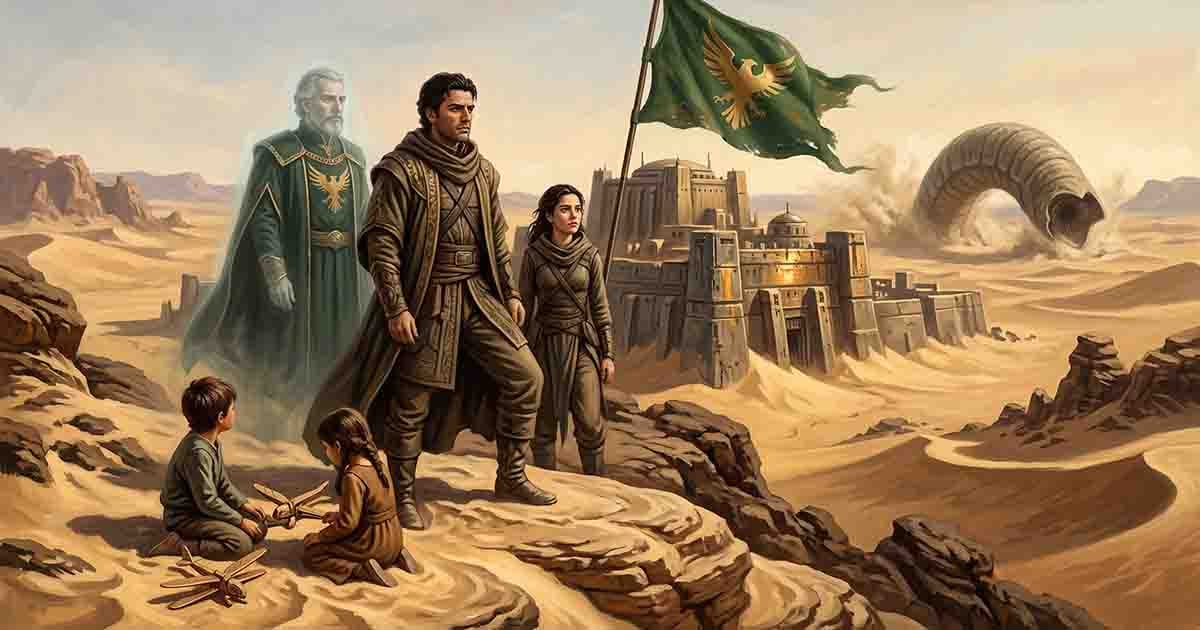
Legacy Across Books and Screens
SPOILER warning for the novels after "Dune." Paul's victory does not merely restore his father's position, since House Atreides becomes the ruling imperial dynasty and Paul's religious authority spreads far beyond Arrakis.
"Dune Messiah" examines the consequences of that victory. "Children of Dune" continues the family story through Paul's sister Alia and his children Leto II and Ghanima. At the same time, "God Emperor of Dune" carries the Atreides legacy thousands of years into the future.
The screen adaptations place different emphasis on the original house. David Lynch's "Dune" (1984) compresses much of the political background, giving viewers the essential betrayal and conflict while moving rapidly toward Paul's transformation.
The 2000 Sci-Fi Channel production "Frank Herbert’s Dune" has considerably more running time for political maneuvering and relationships. Its miniseries format allows the imperial conspiracy and the structure surrounding House Atreides to develop more gradually.
Denis Villeneuve's "Dune" (2021) gives substantial attention to the atmosphere surrounding the family's final days as a functioning Great House. Duke Leto's leadership, Duncan Idaho's loyalty, Arrakis's dangers, and the growing sense of an unavoidable trap receive particular weight.
"Dune Part Two" (2024) shifts the center toward Paul and the Fremen after the destruction of Leto's household. House Atreides survives, but its identity shifts from governing Caladan to the dynastic claim carried by Paul.

Themes and Source List
House Atreides initially appears to offer a humane alternative to Harkonnen cruelty. Its members value loyalty, courage, duty, and personal bonds, qualities that make the destruction of Duke Leto's household one of the great tragedies of "Dune."
Herbert refuses to leave the story there. Through Paul and his descendants, the Atreides become connected with prophecy, religious faith, ecological transformation, control of scarce resources, and increasingly concentrated political power.
The result is more complicated than a contest between a good family and an evil one. House Atreides begins as the victim of an oppressive political order, but its eventual victory creates consequences far greater than Duke Leto could have anticipated.